There’s a specific sound that makes my ears perk up the moment a customer describes it over the phone before they’ve even pulled into the bay: a low, droning hum that rises and falls with vehicle speed, sometimes described as sounding like driving with a window cracked open on the highway, or like a low-flying airplane passing overhead. Almost every time, this turns out to be a wheel hub bearing on its way out, and almost every time, the driver has been living with this noise for weeks or months, assuming it was road noise, tire wear, or “just an older car thing.” I want to walk you through why this noise happens, how to actually pinpoint which wheel it’s coming from, and why ignoring it for too long turns a moderate repair into a genuine safety issue.
What a Hub Bearing Actually Does and Why It Fails the Way It Does
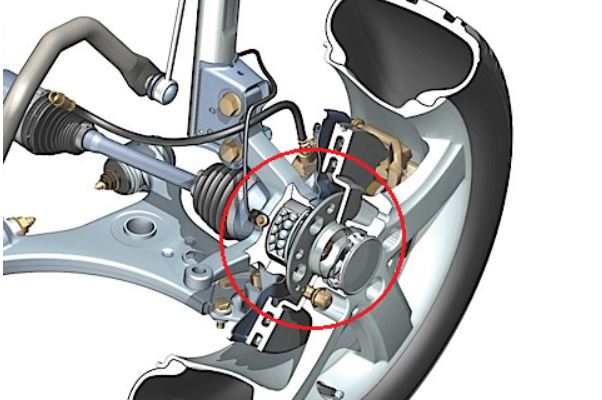
The wheel hub bearing assembly is the component that allows your wheel to spin freely while still being rigidly attached to your vehicle’s suspension and, on most modern cars, it houses the ABS sensor ring as well (the toothed ring that the anti-lock braking system reads to determine wheel speed). Inside this sealed unit sits a set of precision ball or roller bearings packed in grease, sealed against moisture and road debris. When I hoist a car up on the lift to inspect a suspected bearing issue, this is usually what I see: the bearing itself has developed pitting or scoring on the internal races from years of repetitive load cycling, and once that microscopic pitting begins, it accelerates rapidly because the smooth rolling surface the bearings need has been compromised.
Many drivers overlook this, but from a mechanic’s perspective, the real critical point is that hub bearings don’t fail from a single dramatic event in the vast majority of cases—they fail gradually from accumulated micro-damage caused by potholes, curb impacts, and constant cornering loads. Every time you hit a pothole hard enough to feel it in the cabin, you’re potentially creating a tiny brinelling mark (a small indentation in the bearing race caused by impact under load) that doesn’t cause noise immediately but becomes a starting point for corrosion and further pitting over the following months. This is exactly why a bearing can seem to fail “suddenly” from the driver’s perspective, when in reality it’s been quietly deteriorating for a long time.
Just last week, a client brought in a Hyundai Elantra with a complaint of a humming noise that got louder specifically when turning right, and quieter—though not silent—when turning left. This directional change in noise intensity is actually one of the most useful diagnostic clues we have. Loading the bearing through a turn increases pressure on one side of the damaged races, which is why the noise gets more pronounced in one turning direction. In her case, it confirmed the driver’s side front bearing was the culprit, since turning right shifts more weight onto the left side wheels, increasing load on that already-damaged bearing.
How to Diagnose Which Wheel Without Guessing
What would you do if you heard this humming noise but couldn’t tell whether it was coming from the front or the back of the car? This is honestly one of the most common points of confusion, because sound travels and resonates through a vehicle’s chassis in ways that can trick your ears into thinking a rear bearing noise is coming from the front, or vice versa. In my experience, it’s vital to use a systematic approach rather than guessing based on where the sound seems loudest inside the cabin.
The most reliable method I use in the shop is a controlled road test paying attention to three specific variables: speed sensitivity, turning direction, and whether the noise changes when you very lightly apply the brakes while maintaining speed (a failing bearing will often quiet down slightly under light brake application because the reduced wheel speed decreases the load cycling frequency). Beyond the road test, once the car is on the lift, I perform a hand-check by grabbing the tire at the 12 and 6 o’clock positions and rocking it firmly in and out, feeling for any play or looseness that shouldn’t be there. A healthy bearing should show zero perceptible movement. Any detectable wobble, even slight, confirms bearing wear rather than something else like a suspension bushing issue.
Back when I was an apprentice mechanic, one of the biggest trial-and-error mistakes I made was diagnosing a humming noise as a bearing issue without properly ruling out uneven tire wear first. Certain tire wear patterns, particularly cupping (a wavy, scalloped wear pattern on the tire tread caused by suspension or alignment issues), can produce a remarkably similar droning hum that changes with speed. I ended up replacing a bearing that was actually still within acceptable tolerance, and the real issue was a worn strut causing tire cupping. Ever since, I always run my hand across the tire tread surface feeling for that telltale wavy pattern before committing to a bearing diagnosis, and I’d encourage any driver to do the same simple check before assuming the worst.
The Safety Risk Most Drivers Don’t Realize They’re Taking
Here’s the part that genuinely concerns me as a mechanic, beyond just the noise annoyance. A severely worn hub bearing doesn’t just make noise—it introduces play into a component that’s directly responsible for keeping your wheel attached and properly aligned with the road. As deterioration progresses past the early humming stage, you can start to feel actual steering wander or a subtle pulling sensation, because the excessive play allows minute changes in wheel alignment as the bearing shifts under load. In the most severe, long-neglected cases I’ve encountered, the bearing can seize entirely or, in genuinely rare but serious situations, fail catastrophically enough that the wheel develops excessive wobble at speed.
This is not a component I’d ever tell a customer to “keep an eye on and drive on for now” once it’s confirmed through the hand-check test. Unlike some wear items where a bit of extra time doesn’t meaningfully change your risk, a bearing that’s already showing physical play is actively getting worse every mile you drive on it, and the failure curve accelerates rather than staying linear.
[Mechanic’s Essential Checklist: Hub Bearing Diagnosis]
| Symptom | What to Check | What It Confirms |
|---|---|---|
| Humming noise that increases with speed | Road test at varying speeds | Likely bearing wear (early to moderate stage) |
| Noise changes when turning left vs right | Note which direction is louder | Identifies which side the bearing is on |
| Noise fluctuates with light brake tap | Light brake application while rolling | Confirms bearing vs. other noise source |
| Physical wobble when rocking tire at 12/6 position | Hand-check with wheel off ground | Confirms bearing play (moderate to severe) |
| Wavy, scalloped tread pattern on tire | Run hand across tread surface | Rules out tire cupping as false positive |
| ABS warning light combined with humming | Scan for wheel speed sensor codes | Confirms bearing affecting ABS sensor ring |
Realistic Repair Costs and What a Fair Quote Looks Like
For most front-wheel-drive sedans like a Sonata or Elantra, a single wheel hub bearing assembly replacement typically runs $250 to $450 including parts and labor, since most modern vehicles use a sealed hub bearing unit that bolts on as a complete assembly rather than requiring the old-school press-and-remove individual bearing races. If you’re being quoted significantly above this range for a single wheel on a standard sedan, it’s worth asking whether they’re including unnecessary additional work, though larger SUVs or all-wheel-drive vehicles with more complex hub assemblies can legitimately run higher, sometimes $350 to $600 per wheel.
One thing I always tell customers honestly: if one front bearing has failed due to age and mileage rather than a specific impact event, the opposite side bearing has experienced roughly the same cumulative stress and mileage. I don’t automatically push replacing both, but I do flag it as something to monitor, because it’s not unusual for the second side to start showing symptoms within six to twelve months of the first repair.
What You Should Do This Week
If you’ve noticed any humming, droning noise that changes with your speed or with turning direction, don’t wait for it to get dramatically worse before addressing it. Take note of exactly when the noise is loudest, whether that’s during turns, at highway speed, or during light braking, because that information will help your mechanic diagnose the correct wheel far faster than starting from scratch. And if you’re at all mechanically comfortable, the tire rock test at 12 and 6 o’clock with the wheel off the ground is something you can genuinely do yourself in your driveway with a jack, giving you real information before you even step into a shop. A hub bearing repair caught early is a straightforward, predictable expense. One ignored for months becomes a safety conversation I’d rather not be having with you after the fact.
Leave a Reply