Every single week, at least one driver rolls into my bay holding a printout from a tire shop, looking at me like I just told them their car needs a new soul. They ask, “Why is this one three hundred dollars and that one’s ninety, they’re the same size, right?” And that’s usually the moment I grab a rag, wipe my hands, and walk them over to the actual tire still mounted on their car so I can point at the sidewall and explain what I call the “birth certificate” of that tire — the string of numbers and letters that tells you everything about what you’re rolling on.
Here’s the thing that drives me nuts about how this topic gets covered online. Most articles just regurgitate what “P215/65R16” means letter by letter, like a dictionary entry, and call it a day. That’s fine if you just want to pass a trivia quiz. But it doesn’t tell you why a mechanic winces when he sees a mismatched load rating, or why I’ve had to turn customers away because the tire they wanted to buy would technically be illegal — and dangerous — on their vehicle. So let’s actually get into the stuff that matters when the rubber meets the road.
Breaking Down the Sidewall Code Like a Mechanic, Not a Textbook
When I hoist a car up on the lift and start my pre-inspection, one of the first things my eyes go to — before I even touch a wrench — is the sidewall. That little block of text is non-negotiable information, and misreading it is one of the more common (and expensive) mistakes I see DIYers make.
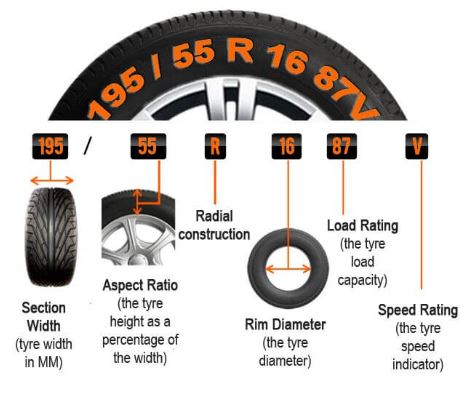
Take a typical designation: P215/65R16 96H. I’ll walk you through this the way I’d explain it to an apprentice standing next to me.
The “P” stands for Passenger vehicle (you might also see “LT” for Light Truck, which means a beefier tire designed to handle bigger loads — trucks and vans towing trailers usually want LT-rated tires, not P-rated ones, even if the size fits, because the internal construction is different). Skip that distinction and you could end up with a tire that’s technically the right diameter but structurally too weak for what you’re hauling. I’ve seen this exact mistake on a customer’s Ford F-150 that was riding on passenger tires his brother-in-law “hooked him up with” — the sidewalls were already showing bulge deformation from carrying camper equipment they were never designed for.
Next, “215” is the tire’s width in millimeters, measured sidewall to sidewall. Then “65” — and this one trips people up constantly — is the aspect ratio, meaning the sidewall height as a percentage of that width. A lower number like 45 means a shorter, stiffer sidewall (common on sportier cars, gives you sharper handling but a rougher ride), while a higher number like 70 means a taller, more cushioned sidewall (smoother ride, more forgiving over potholes, but slightly less crisp cornering feel). “R” just means radial construction, which is essentially universal now — you’re not going to run into old bias-ply tires unless you’re restoring a classic.
The “16” is your wheel diameter in inches — this one has to match your rim exactly, no wiggle room. Then “96” is the load index, a coded number (not a direct weight figure) that corresponds to the maximum weight that single tire can carry when properly inflated. And “H” is your speed rating, a letter code indicating the maximum sustained speed the tire is engineered to handle safely.
Let me be blunt about something most articles gloss over: the load index and speed rating are not decorative. I had a client, a fairly young guy, bring in his Honda Civic complaining about a “weird wobble” at highway speeds. Turned out he’d bought tires online — great price, wrong specs, load index two points lower than what the door jamb sticker called for. The tire itself wasn’t defective. It was just being asked to carry more than it was rated for, especially once he had three passengers and a trunk full of gear. It wasn’t failing catastrophically, but it was flexing more than it should, generating excess heat, and that wobble was the tire essentially telling us it was overworked.
Why “The Same Size” Doesn’t Mean “The Same Tire”
This is the section I wish every driver read before walking into a tire shop, because I watch people get talked into bad decisions constantly, and I also watch people talk themselves out of good ones because they’re chasing the wrong number.
Beyond size, tires are categorized by type, and this is where personal driving habits actually matter more than most people think. You’ve got all-season tires, which are the default for a reason — they’re a compromise built for reasonable grip across a wide temperature range, decent tread life, and acceptable wet performance. Then there are summer (or “performance”) tires, which use a softer rubber compound for maximum grip in warm, dry conditions, but that same soft compound turns rock-hard and loses grip dramatically once temperatures drop below roughly 45°F (7°C) — I’ve seen guys with summer tires spin out in a parking lot during the season’s first light frost because they didn’t realize the compound itself had essentially gone numb. And then winter tires, which use a rubber compound formulated to stay pliable in freezing temperatures and feature aggressive tread patterns with tiny slits called sipes (thin zigzag cuts across the tread blocks that bite into snow and ice for extra traction) that all-season tires simply don’t have enough of.
What would you do if a tire shop tried to sell you “all-season” tires as a year-round solution when you live somewhere that regularly drops below freezing for four months? In my experience, it’s vital to push back on that advice. All-season tires are a “good enough for most people, most of the time” product — they are not a substitute for real winter tires if you’re dealing with actual snow and ice, and treating them as one is how I end up seeing rear-ended sedans in my shop every January.
There’s also the UTQG rating — Uniform Tire Quality Grading — stamped on the sidewall, covering treadwear, traction, and temperature resistance. The treadwear number is comparative, not an exact mileage promise (a 400 isn’t literally “lasts 400 miles,” it’s roughly twice as durable as a tire rated 200 under standardized test conditions), and I always tell customers not to treat it as gospel — driving style, alignment, and inflation habits will swing real-world tread life far more than that number will.
Just last week, a client brought in a Toyota Camry with two mismatched rear tires — one a proper all-season, the other some no-name budget tire with a completely different tread pattern the previous owner had thrown on to save money on a flat repair. Different types, different compounds, different grip characteristics on the same axle. That’s a genuine safety issue, not just an aesthetic mismatch, because it creates uneven handling response between the left and right rear wheel, especially in wet braking. I refused to just “top off the air” and send her on her way — we replaced the pair as a set.
Reading Between the Numbers: Load Range, DOT Codes, and the Stuff Nobody Asks About
Here’s where I’ll share something from my own early days that still makes me a little embarrassed. Back when I was an apprentice mechanic, one of the biggest trial-and-error mistakes I made was assuming that as long as the width and diameter matched, a tire swap was a non-issue. I once helped a senior tech mount a set of tires on a customer’s minivan without paying close attention to the load range — Standard Load versus Extra Load, sometimes marked “XL” on the sidewall. Extra Load tires are built with reinforced sidewalls and slightly higher recommended inflation pressures to safely carry more weight. We didn’t adjust the inflation pressure to match the XL spec, and the customer came back a few weeks later with premature wear on the shoulders of the tread. My senior mechanic caught it, corrected our pressure settings, and gave me a lecture I still repeat to apprentices today: the number on the sidewall isn’t advisory, it’s an engineering spec, and every part of that code changes how you’re supposed to service the tire.
Then there’s the DOT code, which most drivers have never even looked for. It’s a string starting with “DOT” followed by a series of characters, and the last four digits tell you the week and year of manufacture — so “2324” means the 23rd week of 2024. This matters more than people realize because rubber degrades with age regardless of tread depth. I’ve pulled tires off cars with plenty of visible tread remaining, but the tire itself was nine or ten years old, and the rubber had gone brittle — you can actually feel it, a kind of dry, slightly chalky texture when you flex the sidewall, completely different from the supple give of a newer tire. Most manufacturers recommend replacement around six to ten years from the manufacture date regardless of tread wear, and I’ve had a spare tire, of all things, fail a customer because nobody thought to check its age.
Let me put together the checklist I actually use when I’m walking a customer through a tire purchase, because this is the stuff that prevents comebacks to my shop:
| Spec to Check | What It Tells You | Mechanic’s Real-World Note |
|---|---|---|
| Width / Aspect Ratio / Rim Diameter | Physical fit to your wheel and wheel well | Must match your door-jamb sticker unless you’ve confirmed a plus-size fit with a professional |
| Load Index | Max weight capacity per tire | Never go lower than OEM spec, even if the tire “looks” similar |
| Speed Rating | Max sustained safe speed | Downgrading this can void certain insurance claims after an accident |
| Load Range (Standard vs XL) | Sidewall reinforcement and required PSI | XL tires need higher inflation pressure — check your manual, don’t guess |
| Tire Type (All-Season/Summer/Winter) | Compound behavior across temperatures | Match to your actual climate, not just the season on the calendar |
| DOT Date Code | Manufacture week/year | Replace regardless of tread if the tire is 6–10 years old |
| UTQG Treadwear Grade | Comparative durability estimate | Useful for comparing two tires, not a literal mileage guarantee |
I always tell people: this table is basically the pre-flight checklist before you sign anything at a tire shop. If a salesperson can’t answer questions about any row on that list, that’s a signal to ask more questions, not less.
My Professional Verdict
If there’s one thing I want you to walk away with, it’s that the sidewall of your tire is not decoration — it’s a spec sheet written in a code that exists for good reason, and every character on it has a direct relationship to how your car handles, stops, and carries weight. Matching “the size” alone is the bare minimum, not the finish line. Your climate, your typical passenger and cargo load, and the age of the rubber itself all matter just as much as the number stamped in millimeters.
Before your next tire purchase, do yourself a favor: check your door-jamb sticker (not just your old tire’s sidewall, since a previous owner may have installed the wrong ones), write down the full spec including load index and speed rating, and check the DOT date code on your current tires even if the tread looks fine. And if a shop tries to sell you something that deviates from the manufacturer’s original spec without a clear explanation of why, ask them to walk you through it the way I just walked you through it. A good mechanic will never mind explaining the code — it’s the ones who wave you off with “don’t worry about it” that you should be cautious of.
Leave a Reply