There’s a specific kind of hesitation on a customer’s face when I tell them their spark plugs are overdue. It’s not the same reaction as hearing “you need new brakes” or “your tires are bald.” Spark plugs feel invisible—they’re buried in the engine, they don’t squeal at you in traffic, and most drivers have no idea they even exist until something goes badly wrong. I’ve had guys in their sixties who’ve owned a dozen cars in their lifetime tell me, “Wait, spark plugs need to be changed?” And that’s exactly the knowledge gap I want to close today, because ignoring this one $150 service has sent more engines to an early grave than almost anything else I see on the lift.
What a Spark Plug Actually Does (And Why Wear Matters More Than You Think)
A spark plug’s job sounds simple: it takes electrical voltage from the ignition coil and fires a spark across a small gap to ignite the air-fuel mixture inside the cylinder. That controlled explosion is what pushes the piston down and ultimately turns your wheels. Every single power stroke in your engine depends on that spark firing cleanly and at the right moment.
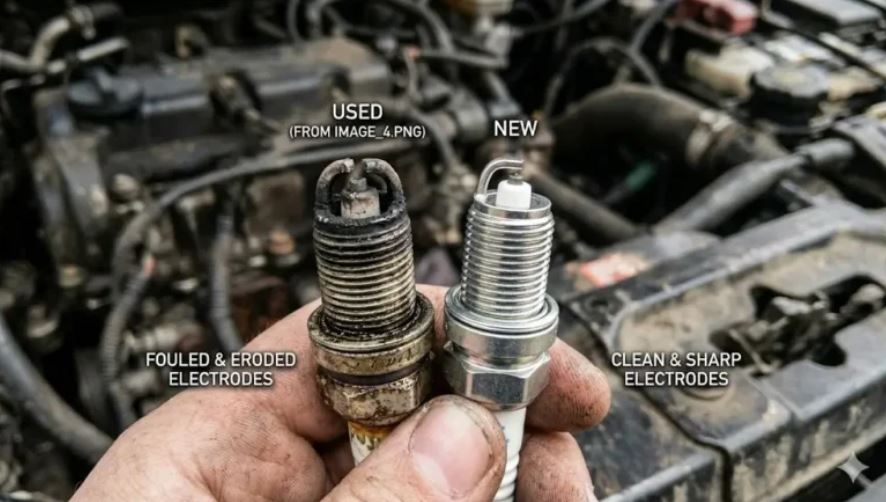
Here’s what most people don’t realize—that spark gap isn’t static. Every time it fires, it erodes a microscopic amount of metal off the electrode tip. On a brand-new plug, that gap might be a crisp 0.044 inches with sharp, well-defined edges. When I pull a plug that’s been in service for 80,000 miles, especially on the original factory plugs, I’m often looking at an electrode that’s rounded off like a pencil that’s been sharpened a hundred times and never gotten thinner—except it has, just unevenly, and the edges have gone soft and mushroom-shaped. That rounded, worn tip requires significantly more voltage to jump the same gap, and when I hook a worn plug up to a spark tester on my bench, you can visibly see the spark struggling—it’s weaker, sometimes yellowish-orange instead of a crisp blue, and it occasionally skips a beat entirely.
Many drivers overlook this, but from a mechanic’s perspective, the real critical point is that a weak spark doesn’t just reduce power—it creates a cascading failure across systems you’d never associate with a spark plug. When ignition becomes inconsistent, your engine’s computer starts running the mixture richer to compensate, which means unburned fuel starts washing down the cylinder walls. That excess fuel dilutes your engine oil over time, degrading its lubricating properties. I’ve pulled dipsticks on cars with badly neglected plugs and the oil smelled distinctly like raw gasoline—that’s not something a filter change fixes.
The Ignition Coil Domino Effect Nobody Warns You About
This is the part of the conversation that really gets people’s attention, because it directly hits their wallet. When I hoist a car up on the lift and pull a spark plug that’s worn down with an excessive gap, the ignition coil sitting on top of it has to work overtime to push voltage across that wider gap. Think of it like trying to jump a wider gap with a garden hose versus a fire hose—the coil is straining every single firing cycle to force that spark across.
Over time, this constant electrical strain generates excess heat inside the coil and breaks down the internal windings. I can’t tell you how many times I’ve diagnosed a “random misfire” code, replaced what the customer assumed was just “a bad coil,” and then found the root cause sitting right underneath it—a spark plug that should’ve been swapped 30,000 miles earlier. Just last week, a client brought in a Hyundai Sonata with a check engine light and a rough idle. The scan tool showed misfire codes on cylinders two and four. A less thorough shop might’ve just thrown two new coils at it and called it a day. When I pulled the plugs, the electrodes were worn down to almost nothing, caked in a light tan deposit that told me the engine was running lean intermittently. I replaced all four plugs for about $80 in parts, and the misfire codes never came back—no coil replacement needed. Had that customer waited another six months, I have zero doubt at least one of those coils would’ve cooked itself, turning an $80 fix into a $400 one.
Back when I was an apprentice mechanic, one of the biggest trial-and-error mistakes I made was assuming a coil failure was always a coil problem in isolation. I replaced a coil on an old Toyota Camry, sent the customer on their way, and had them back in the shop three weeks later with the exact same code on a different cylinder. My mentor at the time just looked at me, pulled the spark plugs himself, and said, “You treated the symptom, not the disease.” That lesson stuck with me for the rest of my career—you always inspect the plug before you condemn the coil.
What Happens When You Push It Too Far: Catalytic Converter Damage
Now here’s where it gets genuinely expensive, and this is the scenario that keeps me up worrying about customers who skip maintenance intervals. When spark plugs are severely worn or start misfiring outright, unburned fuel doesn’t just dilute your oil—it gets pushed straight into your exhaust system. Your catalytic converter (the component that filters harmful emissions using a honeycomb structure coated in precious metals like platinum and palladium) isn’t designed to handle raw, unburned fuel. When that fuel hits the converter’s extreme operating heat, it can literally melt the internal honeycomb structure.
What would you do if your car suddenly started running rough, losing power on hills, and rattling faintly from underneath? Most drivers assume it’s a transmission problem or something exotic. In reality, I’d put money on a melted catalytic converter caused by prolonged misfiring—and a catalytic converter replacement on most modern vehicles runs anywhere from $1,200 to $2,500 depending on whether it’s an aftermarket or OEM part, plus labor. Compare that to a spark plug service that, on most four-cylinder engines, takes me under an hour and costs the customer well under $200 including labor. That’s not a marginal savings—that’s the difference between routine maintenance and a repair bill that makes people question whether to just get rid of the car.
Iridium vs. Copper vs. Platinum: Why the Type of Plug Changes Your Whole Maintenance Schedule
This is a detail that trips up even experienced DIYers. Not all spark plugs are created equal, and the material of the electrode tip directly determines how long it’ll last before it needs replacing. Copper plugs are the softest and cheapest, and they wear the fastest—I rarely see them in anything built in the last fifteen years except certain high-performance or turbocharged applications where the manufacturer actually wants more frequent replacement for consistent performance. Platinum and iridium plugs use a much harder, more heat-resistant metal at the tip, which resists erosion far longer and is standard equipment in the vast majority of daily drivers on the road today.
[Spark Plug Type & Replacement Interval Comparison]
| Plug Type | Typical Lifespan | Approx. Cost (Parts, Per Plug) | Best Suited For |
|---|---|---|---|
| Copper | 20,000–30,000 miles | $2–$5 | Older vehicles, high-performance/racing applications |
| Platinum | 60,000–80,000 miles | $6–$12 | Most standard daily-driver sedans and SUVs |
| Iridium | 80,000–100,000+ miles | $10–$20 | Modern direct-injection and turbocharged engines |
| Double Platinum | 60,000–80,000 miles | $8–$15 | Wasted-spark ignition systems (dual electrode contact) |
The trap I see constantly is customers assuming their car “never needs plugs” because a shop quoted them a 100,000-mile interval once, years ago, and they never revisit it. In my experience, it’s vital to actually check your specific vehicle’s manufacturer service schedule rather than relying on a blanket rule of thumb, because plug life also depends heavily on driving conditions. A car that does mostly short trips, frequent stop-and-go city driving, or towing puts far more thermal and electrical stress on plugs than one that cruises the highway daily. I’ve pulled “100,000-mile” iridium plugs out of delivery vehicles at 65,000 miles that were already showing significant wear because of how much idling and load cycling they endured.
The Diagnostic Signs You Can Catch Before It Gets Expensive
You don’t need a scan tool to catch early spark plug wear if you know what to listen and feel for. A rough idle that you can feel through the seat of your pants—a subtle vibration that wasn’t there a year ago—is often the first sign. Hesitation when you press the accelerator, especially under load like merging onto a highway, is another classic symptom of a weakening spark struggling to keep up with fuel demand. And if you’ve noticed your fuel economy creeping down by two or three miles per gallon without any other explanation, worn plugs are frequently the quiet culprit, since a poor burn means the engine computer compensates with extra fuel to maintain power.
[Mechanic’s Essential Spark Plug Checklist]
| What to Check | How to Check It | What It Means If Abnormal |
|---|---|---|
| Idle smoothness | Feel for vibration at a stoplight in Park/Neutral | Possible early misfire from worn electrode |
| Acceleration response | Note hesitation or “flat spot” when pressing gas | Weak spark under load, common with worn plugs |
| Fuel economy trend | Track mpg over 2–3 fill-ups | Gradual drop signals inefficient combustion |
| Check engine light | Have codes read at any auto parts store (usually free) | Misfire codes (P0300–P0304 range) point to ignition |
| Plug appearance (if DIY) | Pull one plug, inspect tip color and gap | Tan/gray is healthy; black, wet, or rounded tips signal trouble |
If you’re comfortable popping the hood and you’ve got a basic ratchet set, pulling a single spark plug to visually inspect it takes maybe ten minutes on most engines and costs you nothing. A healthy plug should have a light tan or grayish color on the electrode with a well-defined gap. If you see heavy black sooty deposits, that often points to a rich-running condition or oil fouling. If it’s wet with fuel, you’re looking at a misfire in progress. This kind of visual check is something I genuinely encourage customers to try themselves before paying a shop just to look at it.
My final word on this is simple: spark plugs are one of the cheapest insurance policies your engine will ever offer you, and putting off a $150 service to avoid the inconvenience is, in my professional opinion, one of the most financially backwards decisions a driver can make. Pull up your owner’s manual tonight, check your plug replacement interval against your current mileage, and if you’re within 10,000 miles of that number or experiencing any of the symptoms above, get it scheduled this week—not next season, not “when it starts acting up.” By the time it starts acting up, you may already be paying for a coil, a catalytic converter, or both.
Leave a Reply