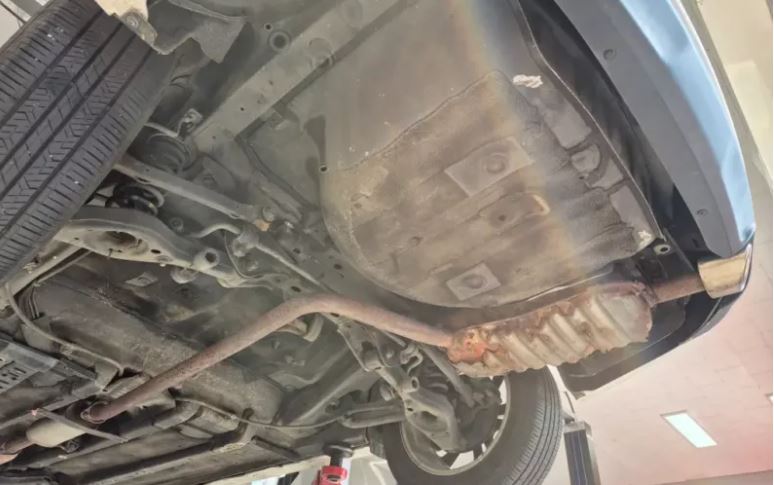
Somewhere around the third week of a car getting noticeably louder, I start seeing the same customer walk through my bay doors with the same sheepish look on their face. “It just kind of happened gradually,” they’ll say, “and honestly it sounds kind of cool now.” I get it—there’s something almost satisfying about a car with a little more growl to it. But here’s the uncomfortable truth I have to deliver almost every single time: that “cool” sound is very rarely an upgrade. It’s decay. And depending on where that decay is happening in your exhaust system, you could be looking at anything from a minor annoyance to a genuine carbon monoxide risk sitting a few feet from your passenger cabin.
Why Your Muffler Gets Louder Over Time (It’s Not Just “Wear and Tear”)
To understand why a muffler gets loud, you have to understand what it’s actually doing when it’s working correctly. Your exhaust system channels hot, high-pressure gases away from the engine through a series of pipes, and the muffler’s job is to use internal baffles and chambers (essentially a maze of metal walls and sometimes packed fiberglass material) to cancel out sound waves before they exit the tailpipe. When I cut open a dead muffler on the bench, what I usually find is either a rusted-through outer shell with a hole punched clean through the metal, or baffles that have physically rattled loose and broken apart from the inside, turning what should be a controlled sound chamber into basically an empty tin can.
Rust is the number one killer, and here’s the detail most drivers don’t think about—your muffler doesn’t just rust from road salt and moisture hitting it from underneath. It actually rots from the inside out just as often, sometimes more aggressively. Every time your engine runs, combustion produces water vapor as a byproduct, and that moisture condenses inside the muffler, especially if you’re someone who does a lot of short trips where the exhaust never gets hot enough for long enough to fully evaporate that condensation. Over years of short commutes, that trapped moisture eats away at the metal from the inside, and by the time you can see rust on the outside, the inside is often significantly worse. When I hoist a car up on the lift and give an old muffler a firm tap with a wrench, a healthy one gives a solid, dull thud. A rotted one gives this hollow, crumbly rattle, and honestly, sometimes rust flakes just fall out of the seams right there on the lift.
Many drivers overlook this, but from a mechanic’s perspective, the real critical point is that the loudness itself is only a symptom—the actual failure is a breach in a pressurized, sealed system that was never supposed to have gaps in it. And that breach is exactly what makes this more than a noise complaint.
The Real Danger: Carbon Monoxide, Not Just Decibels
This is the part of the conversation where I stop being casual and get very direct with customers, because a loud muffler is genuinely a safety issue, not just an inconvenience. Your exhaust system is designed as a fully sealed path that carries combustion gases, including carbon monoxide, away from the engine and out past the rear of the vehicle. When there’s a hole, crack, or separated joint anywhere along that path, exhaust gas can escape before it reaches the tailpipe. Depending on your vehicle’s undercarriage design and where exactly that leak is located, those gases can potentially find their way into the cabin through the floorboards, the trunk seal, or the ventilation system, especially at highway speeds when air pressure changes around the vehicle create a slight vacuum effect that can pull outside air—and exhaust—into the cabin.
Just last week, a client brought in a Hyundai Elantra with exactly this issue. She mentioned almost as an afterthought that she’d been getting mild headaches on her commute and just assumed it was stress from work. When I got the car on the lift, I found a completely separated joint right where the mid-pipe met the muffler, with a gap you could fit two fingers through. That’s not a small leak—that’s exhaust gas venting almost directly underneath the passenger floor pan. I told her flat out that she needed to stop driving that car with the windows up until it was fixed, and I moved her to the front of the queue that day. Carbon monoxide poisoning is genuinely one of the more insidious dangers in vehicle maintenance because you can’t see it, you often can’t smell it in low concentrations, and the early symptoms—headache, drowsiness, mild nausea—get written off as being tired or stressed. What would you do if you started noticing recurring headaches specifically during your commute and nowhere else in your day? That pattern is exactly the kind of thing that should send you straight to a shop for an exhaust inspection, not an aspirin bottle.
Diagnosing the Location: Front Pipe, Mid-Pipe, or Muffler Itself
Not every loud exhaust problem is the muffler specifically, and this is where a lot of well-meaning DIYers waste money by replacing the wrong part. When I’m diagnosing a noise complaint, I listen for where the tone changes as I move a mechanic’s stethoscope or even just my ear along the length of the exhaust with the engine running and the car safely supported. A leak right off the exhaust manifold (the metal component bolted directly to the engine that collects exhaust from each cylinder) produces a sharp, tinny, almost popping sound that’s loudest right under the hood or right at the firewall. A leak further back, at a flex pipe or mid-pipe joint, tends to sound more like a steady drone that gets louder under acceleration and quiets slightly at idle. And a fully rotted muffler produces that classic deep, rumbling roar that’s fairly consistent regardless of throttle position, because the sound-cancelling chambers themselves have failed rather than there being one discrete hole.
Back when I was an apprentice mechanic, one of the biggest trial-and-error mistakes I made was quoting a customer for a full muffler replacement based on sound alone, without actually getting the car in the air first. Turned out the muffler was fine—it was a cracked flex pipe just ahead of it, a much cheaper fix. My mentor caught it before we ordered parts, but it taught me that you diagnose with your eyes and hands, not just your ears from outside the car. That lesson has saved plenty of my customers unnecessary expense over the years, because a full exhaust system replacement and a single flex pipe repair can be a $600 difference.
Cost Reality Check: What a Fair Repair Quote Actually Looks Like
This is where I see a lot of drivers get taken advantage of, particularly at chain shops that push whole-system replacements when a targeted repair would do the job. If the muffler itself is rotted through, replacing just the muffler with a quality aftermarket unit typically runs $150 to $350 in parts depending on your vehicle, plus one to two hours of labor. If it’s isolated to a joint or a small section of pipe, a patch weld or a partial pipe section replacement can sometimes be done for under $200 total, and it’s a completely legitimate repair when the rest of the system is still structurally sound. Where I get skeptical is when a shop insists on replacing the entire exhaust system, from manifold to tailpipe, when only the rear section has failed. Sometimes that’s genuinely necessary—if the pipes are all similarly aged and rusted, doing it piecemeal means you’re back in the shop again in eight months for the next section. But it’s worth asking directly: “Is the rest of my exhaust system structurally sound, or are we replacing all of it preventatively?” A shop that can’t give you a clear, specific answer to that question is one I’d get a second opinion from.
[Exhaust Noise Diagnosis & Repair Cost Comparison]
| Symptom / Sound | Likely Location | Typical Repair Cost | Urgency Level |
|---|---|---|---|
| Sharp, popping tick near the engine | Exhaust manifold gasket/leak | $120–$300 | Moderate–High |
| Steady drone, worsens on acceleration | Mid-pipe or flex pipe joint | $150–$400 | High |
| Deep rumble, consistent at all speeds | Muffler rotted internally | $200–$500 | High |
| Rattling metallic noise over bumps | Loose heat shield (thin metal cover protecting nearby components from exhaust heat) | $50–$150 | Low–Moderate |
| Full system deeply corroded throughout | Entire exhaust system | $600–$1,200+ | High |
What You Should Actually Do This Week
If your car has gotten noticeably louder over the past several weeks, don’t wait for it to get dramatically worse before addressing it, and don’t assume it’s purely cosmetic. In my experience, it’s vital to get the vehicle physically inspected on a lift rather than trying to diagnose exhaust issues from the driver’s seat, because sound alone can be genuinely misleading even to people who’ve been doing this a long time. If you’re mechanically inclined, you can do a basic visual check yourself—park on level ground, let the car cool completely, and slide underneath with a flashlight looking for reddish-brown flaking rust, visible daylight through any section of pipe, or black soot staining around joints, which indicates gas is actively escaping at that seam.
[Mechanic’s Essential Exhaust Checklist]
| What to Check | How to Check It | Warning Sign |
|---|---|---|
| Visible rust or holes | Flashlight inspection under a cooled vehicle | Reddish flaking or visible daylight through pipe |
| Joint connections | Look for soot staining around pipe seams | Black sooty residue means active gas leak |
| Cabin symptoms | Note headaches, drowsiness, or nausea during drives | Possible cabin exhaust intrusion |
| Sound timing | Note if noise changes with acceleration vs. idle | Helps pinpoint leak location before shop visit |
| Heat shield rattle | Listen for metallic buzzing over bumps at low speed | Often a cheap fix, but ignored can worsen |
Whatever you do, don’t drive around for months telling yourself it’s just an aesthetic issue you’ll get to eventually. A loud exhaust is your car directly telling you that a sealed, pressurized system has failed somewhere, and until you get underneath it and see exactly where, you genuinely don’t know whether you’re dealing with a $150 fix or a legitimate health hazard sitting inches from where you and your passengers are breathing. Get it on a lift this week, ask for specifics on exactly where the failure is, and don’t accept a full-system quote without a clear explanation of why anything less won’t do the job.
Leave a Reply