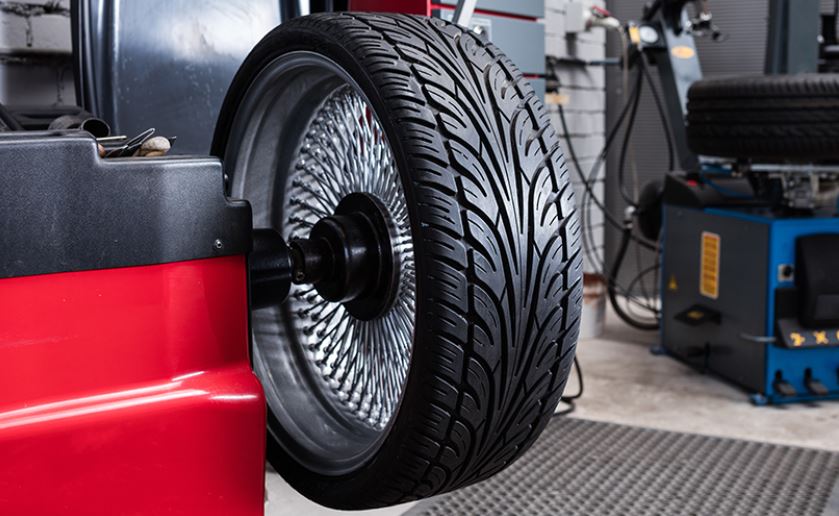
A guy brought his Ford Escape into my bay last month, absolutely convinced he needed new tires. His steering wheel was shaking so bad at 65 miles an hour that his coffee cup was rattling in the cup holder. He’d already priced out a full set online and was ready to drop $600. I put the car on the lift, spun each wheel by hand, and within two minutes I found the real problem: one front tire had lost nearly an ounce and a half of its wheel weights, probably from hitting a pothole hard enough to knock them loose. Fifteen minutes and $60 later, his steering wheel was smooth as glass. No new tires needed. That’s the power of proper balancing, and it’s the single most misunderstood, most skipped maintenance item I see in this shop.
What Balancing Actually Does (And Why Your Tire Isn’t Perfectly Round)
Here’s something most drivers never think about: no tire and wheel assembly is perfectly uniform in weight distribution, even brand new off the shelf. There are slight variations in the rubber density, the metal in the wheel, even the valve stem adds a tiny bit of weight to one spot. When that assembly spins at highway speed — and we’re talking hundreds of rotations per minute — those tiny imbalances get magnified into real vibration you can feel through the seat, the floor, and especially the steering wheel.
Balancing is the process of correcting that by adding small precision weights (usually stick-on or clip-on weights, just a few grams each) to counteract the heavy spots. When I mount a wheel on the balancing machine, it spins the assembly and tells me exactly where the imbalance is and how many grams I need, down to a quarter-ounce. It’s genuinely satisfying work when it’s done right — you’re chasing precision most people never realize their car needs.
What would you do if you felt a vibration only in the steering wheel but not the seat? In my experience, that’s almost always a front tire imbalance, because vibration transmits most directly through the steering column. If it’s in the seat or you feel it in your backside more than your hands, I’m looking at the rear tires first. That little diagnostic trick alone saves me time before I even touch a wrench.
The Real-World Damage an Unbalanced Tire Causes Over Time
This is the part that really gets overlooked. Drivers think an unbalanced tire is just an annoyance — a little shake, no big deal, live with it. But from a mechanic’s perspective, what you’re actually looking at is a slow-motion demolition of several expensive components at once.
An unbalanced wheel doesn’t spin smoothly against the road; it hops, ever so slightly, thousands of times per mile. That repeated micro-impact accelerates wear on your wheel bearings (the assembly that lets your wheel spin freely while supporting the vehicle’s weight), your shocks and struts, and your steering and suspension bushings. When I hoist a car up on the lift with a long-ignored balance issue, I’m typically seeing cupped, scalloped wear on the tire itself — a wavy, uneven pattern you can literally feel with your palm if you run it across the tread. That’s the tire physically bouncing against the pavement instead of maintaining consistent contact.
I had an apprentice year experience that taught me this lesson the hard way. Early on, a customer complained about a mild vibration, and I brushed it off as “probably just needs a balance, no urgency.” Three months later she came back with a wheel bearing so far gone it was audibly growling in the parking lot before she even got out of the car. That $60 balance job I should have pushed for turned into a $380 bearing replacement. I don’t make that mistake anymore, and I don’t let my customers make it either.
Balance vs. Alignment — Stop Confusing These Two
I’d say half the customers who walk in asking for an alignment actually need a balance, and vice versa. They’re not the same thing, and from a diagnostic standpoint, they show up differently. Alignment is about the angles of your wheels relative to each other and the road (think camber, caster, and toe — the geometric positioning that keeps your car tracking straight). A misalignment causes pulling to one side and uneven edge wear on the tire. Balancing, on the other hand, is purely about weight distribution around the wheel, and it causes vibration that typically shows up or worsens at specific speed ranges, often somewhere between 50 and 70 miles per hour.
Many drivers overlook this, but from a mechanic’s perspective, the real critical point is that you can absolutely have a car that’s perfectly aligned but badly out of balance, and vice versa. If your shop tells you that you need both after a proper inspection, that’s not necessarily an upsell — it’s genuinely common for both to drift out of spec around the same mileage interval, especially after hitting a significant pothole or curb.
Mechanic’s Essential Checklist: When to Get Your Tires Balanced
| Situation | What’s Happening | Recommended Action | Estimated Cost |
|---|---|---|---|
| Steering wheel vibrates at 50–70 mph | Front wheel imbalance | Balance front tires | $15–$25 per tire |
| Vibration felt in seat/floor, not wheel | Rear wheel imbalance | Balance rear tires | $15–$25 per tire |
| Just installed new tires | Fresh mount always needs calibrated weights | Balance as part of install | Usually included in mount price |
| Hit a significant pothole or curb | Weight loss or wheel damage | Inspect and rebalance immediately | $60–$100 for full inspection |
| Every 5,000–6,000 miles | Routine weight shift from normal wear | Balance during rotation service | $40–$80 for full set |
| Cupped or scalloped tread wear visible | Long-term unresolved imbalance | Balance plus suspension inspection | $60 balance + possible repair |
| Vibration increases with speed, disappears under braking | Classic imbalance signature | Balance first before assuming bigger issue | $15–$25 per tire |
How Often Should You Actually Get This Done?
I recommend balancing every time you rotate your tires, which for most daily drivers works out to roughly every 5,000 to 6,000 miles, or anytime you hit a pothole hard enough to make you wince. New tire installations should always include balancing as standard practice — if a shop mounts your new tires without balancing them, that’s a red flag, and I’d walk out. It’s such a basic part of the job that skipping it tells you something about the quality of the shop you’re dealing with.
One thing I always tell my customers: balancing isn’t a “fix it once and forget it” service. Weights can shift or fall off, tires wear unevenly over thousands of miles which changes their weight distribution, and normal road impacts knock things out of spec gradually. Think of it less like a one-time repair and more like getting your teeth cleaned — routine maintenance that prevents much bigger problems down the road.
My Final Verdict From the Garage Floor
If there’s one thing I want you to walk away with, it’s this: a vibrating steering wheel is never something to just live with. It’s not a character quirk of your car, and it’s definitely not something that fixes itself. Left alone, it quietly grinds down bearings, bushings, shocks, and the tire itself, turning a $60 problem into a $400 one.
Here’s what I want you to actually do. Pay attention to whether vibration shows up in your steering wheel or your seat, since that tells you front versus rear before you even get to the shop. Get your tires balanced every time you rotate them, no exceptions. Insist on balancing whenever you install new tires, and don’t accept a shop skipping that step. If you’ve recently hit a nasty pothole or curbed a wheel hard, don’t wait for symptoms to show up — get it checked within the week. And if a shop quotes you both an alignment and a balance after a real inspection, don’t assume you’re getting oversold; ask them to show you the readings, because a good mechanic will always be able to explain exactly what they found and why.
Leave a Reply