I can’t tell you how many times a customer has rolled into my bay with brake pads worn down to the metal backing plate, squealing like a dying animal every time they touch the pedal, and when I ask about their driving habits, they describe a commute full of long downhill stretches where they just ride the brake pedal the entire way down. Meanwhile, I’ve got other customers who’ve heard the term “engine braking” thrown around by a buddy or a YouTube video, and they start downshifting aggressively in situations where it can actually do more harm than good. Engine braking sits in this strange gray zone where most drivers either don’t use it at all and burn through brake components twice as fast as necessary, or they misuse it and end up doing damage to their transmission or drivetrain instead. I want to break down exactly what’s happening mechanically when you engine brake, when it genuinely saves you money, and when you need to leave it alone entirely.
What’s Actually Happening Inside Your Engine and Drivetrain
Engine braking, at its core, is the deceleration force your car naturally generates when you take your foot off the gas while the transmission is still in gear, rather than coasting in neutral. When you lift off the accelerator, the throttle plate closes, which restricts airflow into the engine. Since the engine is still mechanically connected to the wheels through the transmission and drivetrain, the wheels are now trying to spin the engine against that restricted airflow, along with fighting compression in each cylinder and internal friction throughout the engine. That resistance translates directly into a deceleration force at the wheels, essentially using your engine as a brake instead of your actual brake pads and rotors.
Many drivers overlook this, but from a mechanic’s perspective, the real critical point is that this isn’t some exotic technique reserved for truckers or performance drivers. It happens every single time you lift off the gas pedal in gear, even if you never consciously think about it. The real skill, and where most drivers go wrong, is in deliberately selecting a lower gear to intensify that effect on a long descent, rather than just letting your automatic transmission stay in a high gear the whole way down while you ride the brake pedal to compensate.
When I hoist a car up on the lift after a customer complains about premature brake wear, this is usually what I see: rotors with a bluish discoloration from overheating, and pads worn down unevenly, often thinner on one side than the other from a caliper that’s been working overtime. Nine times out of ten, when I ask about their driving habits, I find out they live somewhere hilly or mountainous and have never once used a lower gear on a downhill stretch. Their transmission has a perfectly good “L” or manual shift mode sitting there unused the entire time.
How to Actually Use It — Automatic and Manual Transmissions
If you’re driving a manual transmission, engine braking is fairly intuitive once you understand it: as you approach a downhill grade or you’re slowing down for a turn, you downshift into a lower gear before your speed drops too much, and the increased engine resistance at that lower gear ratio does a significant amount of the slowing for you, letting you use your actual brakes far more lightly, mostly just for fine control rather than doing all the work.
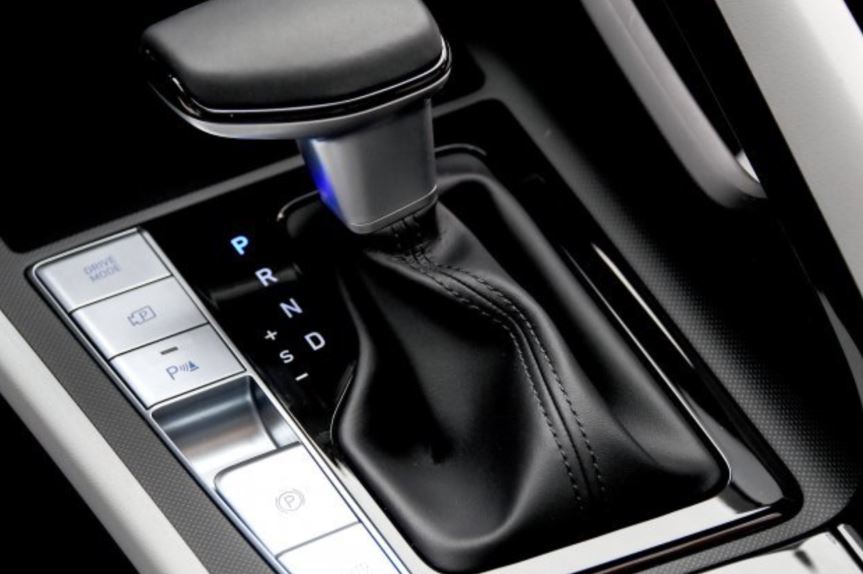
Automatic transmissions are where I see the most confusion, because a lot of drivers don’t even realize their car has options beyond just “D.” Most automatics have a lower gear range, often labeled “L,” “2,” “S,” or on some vehicles paddle shifters that let you manually hold a lower gear even while technically in drive. What would you do if you were heading down a long, steep mountain grade and felt your brake pedal starting to feel soft and less responsive the further down you went? That softness is often the earliest warning sign of brake fade (a dangerous reduction in braking power caused by the brake components overheating from continuous use), and by that point, you’re already behind the curve. The correct move, and one I wish more drivers knew before they needed it, is to shift into a lower gear range before you start the descent, not after you’ve already noticed your brakes struggling.
Just last week, a client brought in a Ford F-150 for a brake inspection after a family road trip through a mountainous area, and she was audibly nervous describing how her brake pedal had gone almost all the way to the floor near the bottom of one particularly long descent. When I got the wheels off, the front rotors were warped enough that I could feel the pulsation just by hand-spinning them, and the pads were cooked, glazed over with a hard, shiny surface that had lost most of its friction capability from sustained overheating. She had no idea her truck even had a tow/haul mode that automatically manages gear selection for exactly this kind of situation. We talked through it, I showed her where the switch was on her console, and I genuinely believe that conversation may have prevented a much more serious incident on her next trip through those mountains.
When Engine Braking Can Actually Hurt Your Car
Here’s where I need to pump the brakes, so to speak, on the idea that engine braking is always the right answer. Downshifting too aggressively, especially at high speeds, can cause what’s called engine overspeeding, where you force the engine to spin at RPMs beyond its safe redline, which risks serious internal damage to pistons, valves, and connecting rods. I’ve seen this happen most often with younger drivers who’ve watched videos about performance downshifting and try to replicate it without understanding their specific vehicle’s RPM limits. Always make sure your tachometer stays within the normal operating range, and if you’re not sure exactly where the redline is on your specific vehicle, that’s information worth confirming before you start aggressively downshifting.
Back when I was an apprentice mechanic, one of the biggest trial-and-error mistakes I made was assuming engine braking was equally gentle on every type of transmission. I had a customer with a continuously variable transmission (CVT, a type of automatic transmission that uses a belt and pulley system instead of fixed gears to provide smoother, stepless acceleration) who wanted to use manual “gear” selection on steep grades the same way you would with a traditional automatic. CVTs simulate gear steps electronically, and while modern ones handle this reasonably well, older or poorly maintained CVT systems can experience additional belt and pulley wear from aggressive simulated downshifting on repeated descents. My senior tech at the time corrected me, and it was a valuable lesson that not every transmission type tolerates aggressive engine braking the same way a traditional manual or torque converter automatic does.
[Mechanic’s Essential Checklist: When to Use Engine Braking]
| Driving Situation | Recommended Action | Why |
|---|---|---|
| Long, steep downhill grade | Shift to lower gear before descent begins | Prevents brake fade from sustained heat buildup |
| Approaching a stop sign on flat road | Light regular braking, engine braking optional | No significant heat risk, minimal benefit |
| Towing a trailer downhill | Use tow/haul mode or manual low gear | Added weight dramatically increases brake heat risk |
| High-speed highway deceleration | Avoid aggressive downshifting | Risk of engine overspeeding past redline |
| CVT-equipped vehicle on steep grade | Use manual mode cautiously, moderate descents only | Reduces belt/pulley strain compared to aggressive use |
| Brake pedal feels soft or spongy | Shift to lower gear immediately, reduce speed | Possible early sign of brake fade |
The Real Cost Savings — And What Neglect Actually Costs You
Let’s talk numbers, because this is ultimately about protecting your wallet as much as your safety. A standard brake pad and rotor replacement, per axle, typically runs somewhere between $250 and $500 depending on your vehicle and whether you’re using standard or performance-grade components. Drivers who consistently ride their brakes on downhill grades instead of using engine braking often find themselves replacing pads and rotors nearly twice as often as drivers who use proper technique, sometimes every 20,000 to 25,000 miles instead of the more typical 40,000 to 50,000 miles you’d expect under normal, well-managed driving conditions. Over the life of a vehicle, that difference can easily add up to a thousand dollars or more in avoidable brake system replacements.
[Component Wear Comparison: Brake-Reliant vs. Engine-Brake-Assisted Driving]
| Component | Brake-Reliant Driving | Engine-Brake-Assisted Driving |
|---|---|---|
| Brake pad lifespan | 20,000–25,000 miles | 40,000–50,000 miles |
| Rotor replacement frequency | Every 1–2 pad changes | Every 2–3 pad changes |
| Risk of brake fade on descents | Moderate to high | Low |
| Fuel consumption on descents | Slightly higher (engine still under load) | Comparable, often improved |
| Transmission wear (if used properly) | N/A | Minimal, within design tolerance |
My Final Verdict as Your Mechanic
Engine braking isn’t some advanced technique reserved for truckers and racecar drivers — it’s a tool sitting right there in your gear selector that most drivers simply never learn to use. If you regularly drive through hilly or mountainous terrain, take the time to actually locate your vehicle’s low gear range or manual shift mode before you need it in an emergency, not while you’re already halfway down a grade with a softening brake pedal. Use it deliberately on long descents, stay mindful of your RPMs so you’re never pushing the engine past safe limits, and if you’re driving something with a CVT, ease into it rather than treating it like a traditional manual gearbox. Your brake pads, your rotors, and honestly your peace of mind on that next mountain drive will thank you for it.
Leave a Reply