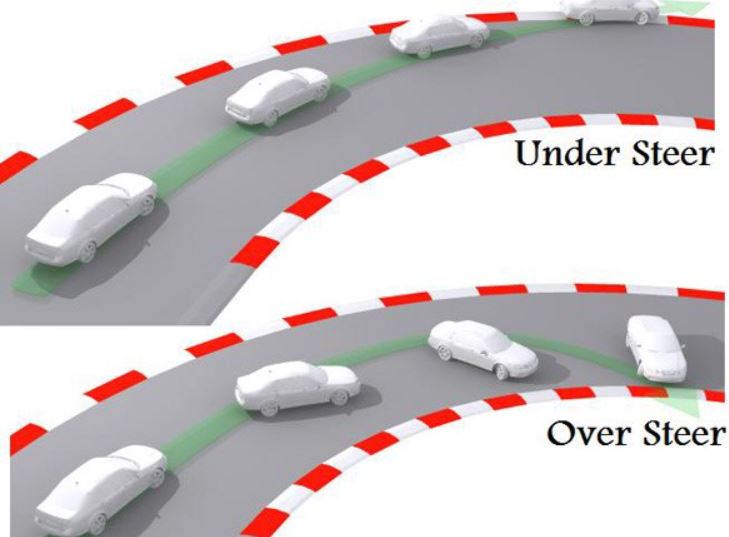
There’s a specific moment every driver dreads, even if they don’t have the vocabulary to describe it. You turn the wheel into a curve, maybe a little too fast because you were distracted or the ramp was tighter than it looked, and the car just… doesn’t listen. Either the front end keeps sliding straight toward the guardrail no matter how hard you crank the wheel, or the back end suddenly steps out sideways like it’s trying to swap places with the front. Both of these are terrifying, and both of them have names: understeer and oversteer. I’ve spent a decade underneath cars, and I can tell you that most drivers who come into my shop after a near-miss or a fender-bender have no idea which one happened to them, let alone why. Today I want to walk you through both, using real garage stories, so that the next time your tires start talking to you, you’ll actually understand what they’re saying.
What’s Actually Happening Under the Car When You Lose Grip
Before we get into the two failure modes, you need to understand a concept I explain to customers almost weekly: the traction budget. Each tire has a finite amount of grip it can generate at any moment, and that grip has to be split between two jobs happening simultaneously — cornering force (turning) and either accelerating or braking force. Think of it like a credit card with a fixed limit. If you spend all your traction budget on braking hard into a corner, there’s nothing left over for turning, and the tire simply stops obeying you. This is the root cause of nearly every oversteer or understeer event I’ve diagnosed, and it’s rarely a mechanical defect — it’s almost always a case of the driver, or the car’s weight distribution, asking too much of one axle at the wrong moment.
Understeer happens when the front tires run out of that traction budget first. The front end “pushes” wide, continuing in a straighter line than the steering angle suggests it should. Oversteer is the opposite — the rear tires lose their grip first, and the back of the car swings around faster than the front, which can spin the car if it’s not caught in time. When I hoist a car up on the lift after a customer describes one of these events, the first thing I check isn’t the steering rack — it’s tire wear patterns, because they tell the real story of what the car has been doing underneath the driver’s seat, often better than the driver can describe it themselves.
Understeer: The Front-Wheel-Drive Driver’s Constant Companion
Most everyday cars, especially front-wheel-drive sedans and crossovers like a Camry, Elantra, or CR-V, are intentionally engineered by the manufacturer to understeer first. This is not a flaw — it’s a deliberate safety decision. Automakers know that an average driver reacts to a car pushing straight (understeer) far more instinctively and safely than a car that suddenly wants to spin (oversteer). Understeer feels scary but is generally more recoverable for an untrained driver: you simply ease off the throttle and unwind some steering lock, and the front tires regain grip.
Many drivers overlook this, but from a mechanic’s perspective, the real critical point isn’t just the driving style — it’s tire condition and inflation. I cannot count how many understeer complaints I’ve resolved simply by checking tire pressure. A front tire running even 4-5 PSI low develops a mushy, rounded contact patch that simply can’t generate the cornering grip a properly inflated tire can. Combine that with worn front tires — and I mean worn specifically on the outer shoulder, which is the telltale wear pattern of a car that’s been cornering hard — and you have a front axle that’s already operating on borrowed traction before the driver even turns the wheel.
Just last week, a client brought in a Hyundai Elantra complaining that the car “wouldn’t turn” on a highway on-ramp and she genuinely thought her steering rack was failing. I road-tested it, and sure enough, at moderate speed through a decreasing-radius curve, the front end pushed wide exactly as she described. Popped the hood, checked tire pressures — front tires were sitting at 26 PSI against a recommended 33 PSI, likely low for months without her noticing. I also found her front tires were down to about 4/32nds of tread while the rears still had 7/32nds, a classic front-wear signature on a front-wheel-drive car that does most of its braking and turning work up front. We aired the tires to spec and I recommended a front tire replacement, and within days she reported the “phantom steering problem” had vanished. No parts were broken. The car was simply being asked to do a job its tires physically could not perform.
Here’s a question worth asking yourself: what would you do if your car started pushing wide in a turn right now, today, on your commute? The correct mechanic’s answer is counterintuitive to most people’s instincts — you do NOT add more steering lock, and you do NOT slam the brakes. Adding steering angle when the front tires are already saturated does nothing but increase the slip angle further; the tires are already turned as much as they can effectively use. The right move is to smoothly ease off the accelerator, which shifts weight forward onto the front tires and restores some of that traction budget we talked about, allowing the fronts to bite again.
Oversteer: When the Back End Wants to Lead
Oversteer is the less common but more dangerous cousin, and it shows up far more often in rear-wheel-drive and all-wheel-drive performance cars — think a Genesis G70, a BMW 3 Series, or a Mustang — though it absolutely can happen in a front-drive car too, usually under hard braking or a sudden lift-off-throttle mid-corner (a phenomenon called “lift-off oversteer” or “trailing throttle oversteer”).
Back when I was an apprentice mechanic, one of the biggest trial-and-error mistakes I made wasn’t even on a customer’s car — it was learning to drive a rear-drive shop loaner in the rain. I came into a wet roundabout too hot, lifted off the throttle abruptly out of fear, and felt the rear end snap around faster than I could process. Weight transfer had shifted off the rear tires the instant I lifted the throttle, and with less vertical load on the rear contact patches, they lost grip before the fronts did. I countersteered too late and too much, and the car did a slow, humiliating pirouette in an empty parking lot I’d thankfully diverted to first. That lesson stuck with me for life: with oversteer, your hands need to react before your brain finishes being afraid.
The technical fix, and what I now teach every customer who drives a rear-wheel-drive car, is to countersteer — turning the wheel in the direction the rear of the car is sliding — while simultaneously and smoothly getting back on the throttle if the car is a rear or all-wheel-drive layout, which helps transfer weight rearward and restore grip to those rear tires. This is the opposite instinct of what you do for understeer, which is exactly why confusing the two is so dangerous. Stomping the brakes during oversteer almost always makes it worse, because hard braking transfers even more weight forward and off the already-slipping rear tires.
On the mechanical side, when a customer’s oversteer complaint isn’t purely a driving-technique issue, I go straight to the rear suspension and rear tires. Worn rear shocks or struts allow excessive weight transfer during quick direction changes, exaggerating oversteer tendencies. I also check rear tire tread depth relentlessly — and here’s a detail most drivers never consider: if you rotate your tires infrequently and end up putting your best, deepest-tread tires on the front axle “because that’s where the power steering feels heaviest,” you are unknowingly building a car that oversteers in the wet. The rear axle needs at least as much grip as the front, arguably more on a rear-drive car, and putting your worn tires on the back is a mistake I see constantly, especially with DIY-minded owners who rotate tires themselves but reverse the logic.
The Mechanic’s Essential Checklist for Diagnosing Which One You’re Dealing With
To help you sort through this the next time something feels off, here’s the checklist I actually run through in the shop.
| Symptom / Check | Points to Understeer | Points to Oversteer |
|---|---|---|
| Which end feels “light” or slides first | Front end pushes wide, wheel feels vague | Rear end swings out, tail feels loose |
| Tire wear pattern | Outer shoulder wear on front tires | Outer shoulder wear on rear tires |
| Common drivetrain layout | Front-wheel-drive sedans, crossovers | Rear-wheel-drive, high-power AWD |
| Trigger scenario | Entering a corner too fast, cold tires | Lifting off throttle mid-corner, hard braking while turning |
| Correct driver response | Ease off throttle, reduce steering angle | Countersteer, smoothly reapply throttle (RWD/AWD) |
| Underlying mechanical cause to check | Low front tire pressure, worn front tread, weak front struts | Worn rear shocks, worn rear tires, rear-heavy tire wear imbalance |
Component Replacement Schedule Relevant to Handling Balance
Since both conditions are heavily influenced by suspension and tire condition rather than some exotic hidden defect, here’s realistic guidance on when these parts typically need attention, based on what I actually see coming off customer cars.
| Component | Typical Replacement Interval | Realistic Cost Range (Parts + Labor) |
|---|---|---|
| Tires (all four, rotated regularly) | 40,000–60,000 miles | $500–$900 for a set on a midsize sedan |
| Struts/Shocks (front or rear pair) | 60,000–90,000 miles | $300–$600 per axle |
| Sway bar end links/bushings | 60,000–80,000 miles | $100–$250 per axle |
| Wheel alignment | Every 10,000–12,000 miles or after tire replacement | $80–$150 |
That alignment line item is one people skip constantly to save a hundred dollars, and it’s a mistake. A car with even slightly misaligned camber or toe will develop uneven, accelerated wear on exactly the tires responsible for understeer or oversteer, and you’ll be chasing a handling “mystery” that’s really just geometry.
My Final Word on This
If there’s one thing I want you to walk away from this article with, it’s that understeer and oversteer are not random acts of a car “acting up” — they are physics responding predictably to weight transfer, tire condition, and driver input, and in the vast majority of cases I’ve handled, the mechanical fix is far cheaper and simpler than drivers assume. Before you assume something expensive is broken, check your tire pressures this weekend, inspect your tread wear pattern on all four corners, and if you haven’t had an alignment done in the last year, schedule one. Then take a moment, next time you’re in an empty parking lot, to genuinely understand which way your particular car tends to misbehave when pushed, because knowing that in advance, calmly, is worth more than any warning light on your dashboard.
Leave a Reply