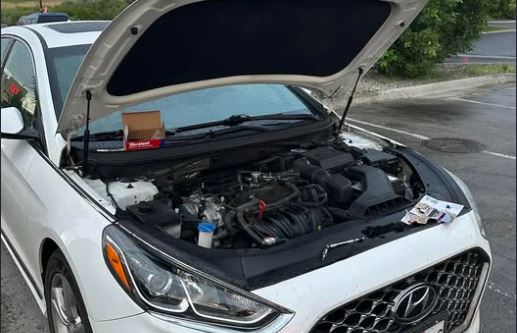
A customer once rolled into my bay convinced his transmission was dying. His Chevy Malibu was hesitating on acceleration, idling rough enough to shake the console, and occasionally throwing out a puff of rich-smelling exhaust that made his eyes water when he walked behind it. He’d already gotten a quote from another shop for a transmission flush and a laundry list of related work. Twenty minutes on my scan tool later, I found the real culprit: a MAP sensor reading that was stuck feeding the engine computer bad information. Total fix, once we knew what we were looking at, was under a hundred dollars in parts. That gap between what he almost paid and what the actual problem cost to fix is exactly why I wanted to write about this sensor specifically — it’s small, it’s cheap, and it causes an outsized amount of confusion and unnecessary spending.
What the MAP Sensor Actually Does and Why the Engine Can’t Function Without It
MAP stands for Manifold Absolute Pressure, and the sensor itself is a small component, usually about the size of a matchbox, mounted on or near your intake manifold (the part of the engine that distributes air to each cylinder). Its job is to constantly measure the air pressure inside that manifold and report it to your engine control unit, or ECU (the onboard computer that manages fuel injection, ignition timing, and dozens of other real-time engine functions).
Here’s the part most explanations skip over: your engine doesn’t actually know how much air is entering it just by existing. It needs a reference point, and manifold pressure is one of the two primary ways engines calculate that — the other being a mass airflow sensor, which some vehicles use instead of or alongside a MAP sensor. When you press the gas pedal, the throttle plate opens wider, air pressure inside the manifold rises toward atmospheric pressure, and the MAP sensor detects that shift in real time. The ECU then uses that pressure reading, combined with engine RPM and intake air temperature, to calculate exactly how much fuel to inject and when to fire the spark plugs. Get that pressure reading wrong, even by a small margin, and every single one of those downstream calculations gets thrown off too.
Many drivers overlook this, but from a mechanic’s perspective, the real critical point is that the MAP sensor isn’t just “one input among many” — it’s foundational to the engine’s fuel-air ratio calculation. When I hoist a car up on the lift and start diagnosing a rough-running engine, a bad MAP sensor reading doesn’t usually cause one weird symptom. It causes a whole cluster of them simultaneously, because the ECU is essentially flying partially blind and overcorrecting or undercorrecting fuel delivery across every cylinder at once.
The Specific Symptoms I Look For (And Why They Happen)
What would you do if your car suddenly started idling roughly, like it’s got a slight tremor, while also feeling sluggish off the line but then oddly surging once you’re already cruising at speed? That inconsistent, almost contradictory symptom pattern is actually one of the more reliable fingerprints of a failing MAP sensor, and here’s the mechanical reason why it presents that way instead of just one clean symptom.
A failing MAP sensor typically doesn’t die instantly — it degrades, often producing a signal voltage that drifts, spikes intermittently, or reads incorrectly under specific pressure conditions rather than across the board. At idle, when manifold pressure is at its lowest and most vacuum-heavy state, a drifting sensor might report a pressure reading that’s too high, tricking the ECU into thinking the engine needs less fuel than it actually does, which is when you get that lean, uneven, almost stumbling idle — I can usually feel that specific tremor through the hood when I rest my hand on it, a faster, choppier vibration than the smoother rough idle you’d get from something like a vacuum leak. Then, under acceleration, if the sensor swings the other direction and reports pressure too low, the ECU dumps in extra fuel it doesn’t need, and that’s your hesitation on takeoff followed by that rich, slightly sulfurous exhaust smell and sometimes a puff of black smoke, particularly on cold starts.
You’ll also frequently see a check engine light with specific trouble codes — commonly something in the P0106 through P0109 range, which correspond to MAP sensor circuit performance, range, or intermittent signal problems (a trouble code is a standardized diagnostic reference number the ECU stores when it detects a reading outside expected parameters, which a scan tool can retrieve). But here’s a detail that trips up a lot of DIYers doing their own diagnosis: MAP sensor codes can look nearly identical on paper to codes for a vacuum leak, a failing throttle position sensor, or even certain fuel injector problems, because all of them ultimately mess with the same air-fuel ratio calculation from different angles. I’ve had customers replace a MAP sensor themselves based purely on a code reader result, only to have the exact same symptoms return because the real issue was a cracked vacuum hose feeding false pressure readings to a perfectly healthy sensor.
Just last week, a client brought in a Hyundai Elantra with almost this exact confusion already baked in — he’d bought a MAP sensor online based on his own code reader diagnosis, installed it himself, and called me frustrated because the rough idle hadn’t improved at all. When I got it on my scanner and watched live data while wiggling hoses under the hood, I found a small vacuum line near the sensor with a hairline crack, invisible until you flex it, that was letting in unmetered air. The new sensor was reading exactly what it was supposed to read — it just had bad air pressure information to work with in the first place, garbage in, garbage out. That’s an important lesson: the sensor reports reality, it doesn’t create it, so before you replace one, you need to rule out whether something else is corrupting the pressure inside that manifold to begin with.
Diagnosing It Properly and Knowing What a Fair Repair Actually Costs
This is where I want to save you some money, because MAP sensor replacement is one of the more DIY-friendly repairs on most vehicles, and a shop quote that seems inflated might genuinely be inflated, or it might reflect a harder-to-reach sensor location depending on your specific engine bay layout.
A proper diagnosis starts with live data, not just a trouble code. I hook up a scan tool capable of showing real-time MAP sensor voltage or pressure readings, then watch how that number behaves at idle, during a slow throttle increase, and during a quick throttle snap. A healthy sensor should show a smooth, responsive, and proportional change — no flatlines, no erratic jumps, no lag. If I see the reading stick or jump unpredictably while the engine’s actual behavior is smoothly changing, that’s a strong indicator the sensor itself is the problem rather than something upstream feeding it bad air.
Before condemning the sensor, though, I always do a visual and physical inspection of the vacuum lines and connector first, because in my experience, it’s vital to rule out the cheap explanation before replacing the more expensive part. That means checking the electrical connector for corrosion or a loose pin, and inspecting the vacuum hose (if your particular sensor uses one, since some are mounted directly on the manifold without a separate hose) for cracks, especially near the ends where the rubber tends to dry out and split first from constant flexing and heat exposure.
Here’s a realistic cost breakdown I give customers so they know what to expect and can sniff out a quote that’s out of line:
| Service | Typical Cost Range | Mechanic’s Note |
|---|---|---|
| MAP Sensor Part Only | $25–$90 | OEM tends to run higher than aftermarket; stick with OEM or a reputable brand on this part specifically |
| DIY Replacement (Parts Only) | $25–$90 | Usually a 10–20 minute job with basic hand tools on most engines |
| Shop Labor for Replacement | $40–$100 | Should be quick labor unless the sensor is buried under intake components |
| Full Diagnostic (if unclear) | $80–$150 | Worth paying for if you’ve already thrown a guessed part at it once |
| Related Vacuum Hose Repair | $20–$60 | Often the real culprit — always ask your shop to check this first |
If a shop quotes you several hundred dollars for a straightforward MAP sensor swap on a vehicle where the sensor is easily accessible, that’s worth questioning, and asking them directly why labor time is estimated the way it is. On the flip side, if your particular engine has the MAP sensor buried under the intake manifold or other components, a higher labor quote can be entirely legitimate, so it’s worth asking specifically about accessibility on your make and model rather than assuming every quote should match the cheapest number you found online.
My Professional Verdict
If your car is idling rough, hesitating on acceleration, occasionally surging, and throwing a check engine light with a code in that P0106 to P0109 family, don’t jump straight to replacing the MAP sensor as your first move, and definitely don’t let anyone talk you into transmission work or unrelated repairs based on symptoms alone. Get a proper live-data scan first, have the vacuum lines and electrical connector physically inspected, and only replace the sensor once you’ve confirmed it’s actually the component misbehaving rather than an innocent bystander reporting bad information it received from somewhere else.
Before your next visit to a shop for these symptoms, walk in armed with this: ask specifically whether they pulled live MAP sensor data or just read a trouble code, confirm whether they inspected the vacuum lines and connector before recommending sensor replacement, get the part cost and labor cost broken out separately so you can compare against typical ranges, and don’t authorize any additional repairs, like transmission service, until the MAP sensor fix has had a chance to resolve the symptoms on its own. In my experience, this is one of the cheapest, most satisfying fixes in the business precisely because the diagnosis, done right, is so much more valuable than the part itself.
Leave a Reply