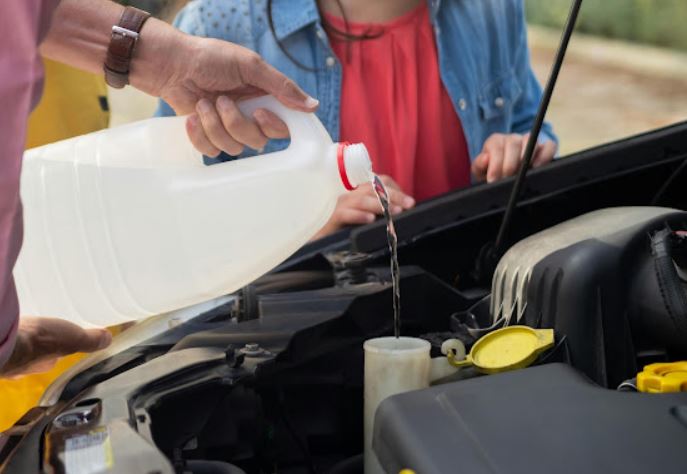
I had a guy pull into my bay this past winter with a busted washer fluid reservoir, cracked clean through, and washer fluid lines split in two places. He was confused, insisting he’d “never had this happen before.” When I asked what he’d been running in the reservoir, he said plain tap water, had been doing it for years to save a few bucks. That right there was the whole story. He got lucky it only cost him a reservoir and some lines. I’ve seen this exact mistake take out a washer pump too, and that’s a considerably more annoying repair.
This is one of those corners drivers cut without realizing there’s an actual engineering reason not to. Water seems harmless, it’s basically what washer fluid is mostly made of anyway, right? But that thinking skips over exactly why washer fluid isn’t just water with some blue dye in it, and why that difference matters more in certain seasons than others. Let me walk you through what’s actually going on inside that reservoir and why plain water is a gamble that isn’t worth the savings.
The Freezing Problem Nobody Thinks About Until It’s Too Late
Here’s the core issue, and it’s simpler than most people expect: water freezes at 0°C, and washer fluid is specifically formulated with methanol or ethylene glycol-based antifreeze agents to stay liquid well below that, often down to -20°C or colder depending on the fluid’s rating. When straight water sits in your reservoir overnight during a cold snap, it doesn’t just get slushy, it expands as it freezes, because water is one of the few substances that increases in volume when it transitions from liquid to solid.
That expansion is the actual mechanism of damage, and it’s something a lot of drivers don’t connect until I explain it on the lift. When I pull a cracked reservoir off a car, I can usually tell right away it’s freeze damage rather than impact damage, because the crack pattern is different. Impact cracks tend to be sharp, localized, and radiate from a single point of contact. Freeze cracks are broader, sometimes almost a clean split along a seam or thin wall section of the plastic, because the ice formed inside pushed outward evenly against the container walls until something gave.
Many drivers overlook this, but from a mechanic’s perspective, the real critical point is that the damage doesn’t always show up immediately. Sometimes the reservoir cracks slightly but doesn’t fully fail until a few days later, once it’s cycled through a few freeze-thaw periods and the stress fracture finally propagates all the way through. That’s why some customers tell me “it was fine last week,” and I have to explain that the failure was likely already happening beneath the surface.
What would you do if you hit your washer fluid button on a cold morning and heard a weird gurgling sound followed by nothing coming out? Most drivers just assume they’re out of fluid, but if it’s genuinely cold outside and you’ve been running water, that gurgle is very possibly ice forming in the lines, and continuing to mash that button repeatedly is exactly how you burn out a washer pump.
What Running Water Actually Does to Your Washer Pump and Lines
I want to get specific here, because this is where the real mechanical damage happens, not just at the reservoir. Your washer pump (the small electric motor submerged inside or beside the reservoir that pushes fluid through the lines to your nozzles) is designed to move liquid, not push against solid ice. If you turn your car on during a freeze and hit the washer button without realizing the fluid is frozen solid inside the reservoir or lines, that pump tries to spin against a blockage it can’t overcome. I’ve pulled more than a few of these pumps out over the years, and you can genuinely smell the difference, there’s a faint burnt electrical odor from the motor windings straining against resistance they were never built to handle.
A washer pump replacement typically runs $60-120 including labor, depending on the vehicle and how accessible it is. That’s not devastating, but it’s a completely avoidable cost for something that a $6 jug of proper washer fluid would have prevented entirely.
Beyond the freezing issue, there’s a mineral deposit problem that’s easy to overlook, especially if you’re topping up with tap water rather than distilled. Tap water contains dissolved minerals, calcium and magnesium primarily, and over time as that water evaporates slightly or cycles through your system repeatedly, those minerals can leave deposits inside the narrow washer lines and especially inside the tiny nozzle openings. I’ve cleared clogged washer nozzles with a fine sewing needle more times than I can count, and a good number of those cases trace back to mineral buildup from years of tap water use rather than any fluid contamination.
Just last week, a client brought in a Honda Civic with a washer spray pattern that had gone from a clean, even fan shape to a weak, lopsided dribble on the driver’s side. She swore she hadn’t touched anything. When I pulled the nozzle and looked closely under a light, there was a visible crust of white mineral buildup partially blocking one of the two spray channels. We cleared it, flushed the system, and switched her over to proper washer fluid, and the spray pattern came back to normal immediately.
There’s also a cleaning performance gap that matters more than people expect, especially heading into road salt season. Washer fluid contains detergents and solvents specifically formulated to cut through road grime, bug residue, and salt film, none of which plain water handles particularly well. You end up mashing the washer button repeatedly trying to clear a windshield that water just isn’t equipped to clean, and that repeated pump cycling adds unnecessary wear on top of everything else.
Making the Right Call for Your Climate and Season
I’m not going to tell you that water is dangerous in every single scenario, because context matters here. If you live somewhere that genuinely never sees freezing temperatures, water carries less risk on the freeze-expansion front, though you’ll still deal with reduced cleaning performance and potential mineral buildup over time. But even in warmer climates, I’d still lean toward proper washer fluid, because the cost difference is minimal and the cleaning performance difference is significant enough to matter every single time you’re driving behind a truck kicking up road spray.
Back when I was an apprentice mechanic, one of the biggest trial-and-error mistakes I made was assuming a customer’s cracked reservoir was accident damage from a recent fender bender, purely based on timing. Turned out it was freeze damage from weeks earlier that had simply been slowly failing until it finally gave out. I learned to always ask about washer fluid habits before jumping to conclusions on reservoir damage, because the visual clues are genuinely different once you know what to look for.
Here’s a table I keep on hand for customers who ask about washer fluid selection through the seasons:
| Mechanic’s Essential Checklist | Recommendation | Why It Matters |
|---|---|---|
| Summer washer fluid | Standard cleaning formula | No freeze risk, prioritize bug/grime removal |
| Winter washer fluid | Rated to at least -20°C or your regional low | Prevents freeze expansion damage to reservoir/lines |
| Never use plain tap water | Especially October through March | Freeze expansion risk plus mineral buildup |
| Check fluid rating before first freeze | Read the freeze-point label on the jug | Some cheap fluids are only rated to -10°C, insufficient for harsh winters |
| Distilled water only if diluting | Never dilute in freezing climates | Tap water minerals clog narrow nozzle openings |
| Inspect nozzles seasonally | Clear with a fine needle if spray is weak | Mineral or debris buildup restricts spray pattern |
One more thing worth mentioning: don’t assume a full reservoir of water is somehow “better than nothing” heading into winter. I’d genuinely rather see a customer run their reservoir low or even empty through a hard freeze than have it full of water sitting there ready to expand. If you’ve been running water and a cold snap is coming, it’s worth draining what you can and refilling with proper fluid rather than just topping off water with fluid and diluting your freeze protection down to something less effective than either option alone.
Final Verdict and Your Action Checklist
My honest professional take is this: the few dollars you save running tap water instead of washer fluid isn’t worth the risk of a cracked reservoir, a burnt-out pump, or clogged nozzles, especially once winter temperatures come into play. Washer fluid is formulated the way it is for specific mechanical reasons, not as a marketing gimmick, and skipping it is one of those false economies that ends up costing more than it saves.
Here’s what I want you to do this week. Check what’s actually in your washer reservoir right now, not what you assume is in there. If it’s water, or a heavily diluted mix, drain it if you can and refill with a proper washer fluid rated for your climate’s coldest expected temperature. Test your washer spray on both nozzles to confirm an even, full pattern on each side, and if you notice a weak or lopsided spray, check for mineral buildup before assuming it’s a pump issue. Heading into any seasonal temperature drop, make this a five-minute check alongside your tire pressure and oil level, because it’s a cheap habit that prevents a genuinely annoying and avoidable repair.
Leave a Reply