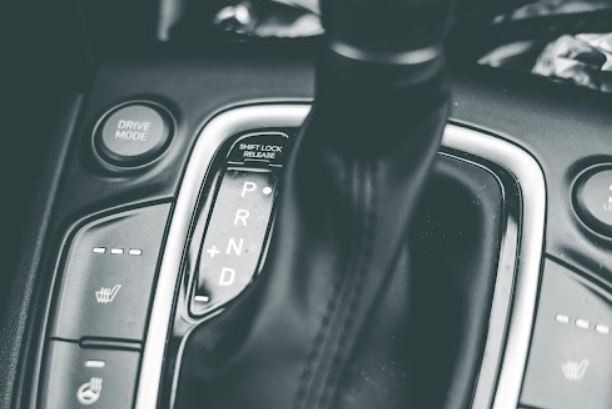
I want to clear something up today because it’s one of those topics where I see drivers doing the wrong thing constantly, and honestly, even some mechanics give bad advice on this one. Every single day at that long light near my shop, I watch cars idling in Drive with a foot mashed on the brake pedal for two, sometimes three minutes at a stretch. Then on the other end of the spectrum, I get customers who shift into Park or Neutral at every single stop sign, convinced they’re saving their transmission. Both habits come from somewhere, but neither one tells the full story, and getting this wrong over years of driving can genuinely cost you real money in transmission wear.
Why Sitting In Drive At Long Lights Isn’t Actually “Fine”
Let’s talk about what’s physically happening inside your transmission when you’re stopped at a light with your foot on the brake and the shifter still in D. Your torque converter (the fluid coupling that transfers power from your engine to your transmission, essentially acting like a rotating clutch filled with fluid) never fully disengages in Drive. Even at a complete stop, it’s still trying to transmit rotational force to the transmission input shaft. Your brakes are fighting against that constant forward pressure the entire time you’re sitting there.
Many drivers overlook this, but from a mechanic’s perspective, the real critical point is heat. That torque converter is generating friction heat internally the whole time you’re stopped in gear, and on a scorching summer day stuck at a five-minute construction light, that heat has nowhere good to go. When I hoist a car up on the lift for a transmission fluid service and I pull the fluid from a car whose owner admits they idle in Drive constantly at long lights, it’s noticeably darker and has a faint burnt smell compared to a car whose owner is more mindful about it. That’s not scientific proof from a lab, but after ten years of pulling transmission pans, I trust what my nose and eyes tell me.
There’s also the brake wear angle that nobody talks about. Holding a car stationary against the torque converter’s forward push requires more consistent brake pad pressure than holding a car that’s already in Neutral with no forward force fighting it. It’s a small difference per stop, but multiply that by thousands of stops over the life of a vehicle and you’re looking at measurably faster pad wear.
So Should You Shift To Neutral At Every Red Light? Not Exactly.
Here’s where I have to push back on the other extreme, because I get this question constantly from customers who read something online and now shift to Neutral at every stop sign, including quick two-second stops. What would you do if you were stopped at a light for maybe five to ten seconds behind two other cars? Honestly, in that scenario, I’d just stay in Drive with my foot on the brake. Shifting in and out of gear repeatedly for brief stops actually introduces its own wear pattern, specifically on the shift solenoids and the internal clutch packs that engage each gear range.
Just last week, a client brought in a Hyundai Sonata with a complaint about a delayed or “clunky” engagement when shifting from Park into Drive in the mornings. When I scanned it and pulled the transmission adaptation data, along with hearing her driving habits, it turned out she’d developed a habit of shifting to Neutral at literally every stop, even brief ones behind a single car at a stop sign. That repetitive shifting, especially combined with slightly low fluid level, had accelerated wear on her shift solenoid pack. The repair wasn’t catastrophic, a solenoid pack replacement ran her about $340 including labor, which is a fair price for that job, but it was a completely avoidable expense.
My actual rule of thumb, and this is what I tell every customer who asks, is based on duration. For a normal light cycle where you’ll likely be stopped under fifteen or twenty seconds, Drive with your foot firmly on the brake is perfectly fine and won’t meaningfully harm anything. For longer stops, extended construction delays, railroad crossings, or any situation where you know you’ll be sitting for thirty seconds or more, shift into Neutral and let your foot rest, or use your parking brake if you’re going to be there a while. That reduces the sustained heat buildup in the torque converter without introducing the wear pattern that comes from constant in-and-out shifting at every single stop.
The Uphill Stop Situation Nobody Prepares You For
This next scenario is where I’ve genuinely seen drivers cause real damage, and it deserves its own conversation. When you’re stopped on an incline, whether it’s a hill start situation at a light or a steep driveway, resist the urge to hold the car in place using only the accelerator pedal while in Drive, sometimes called “riding the brake and gas together” or just gently feathering the throttle to prevent rollback. I understand the instinct, but doing this regularly puts you in a situation where the transmission is trying to move the car forward while gravity pulls it back, and that fight generates significant heat and clutch pack wear inside the transmission, on top of unnecessary engine load.
Back when I was an apprentice mechanic, one of the biggest trial-and-error mistakes I made was underestimating just how much damage this specific habit causes over time. I worked on a Kia Sorento that came in with premature transmission slipping at only 68,000 miles, which is far too early for that kind of wear under normal circumstances. After talking with the owner, we learned she lived at the top of a steep hill and used exactly this technique to hold her position at the stop sign near her house every single day for years. That habit, repeated thousands of times, contributed directly to accelerated internal wear. The fix at that point wasn’t cheap either, a transmission rebuild or replacement typically runs anywhere from $2,800 to $4,500 depending on the vehicle, versus a simple habit change that costs absolutely nothing.
The correct approach on an incline is to use your foot brake to hold the car, and if you anticipate a longer wait, engage your parking brake. Many newer vehicles also come equipped with hill-hold assist, a system that automatically maintains brake pressure for a second or two after you release the brake pedal, giving you time to transition to the gas without rolling backward. If your vehicle has this feature, use it, that’s genuinely what it’s designed for.
Quick Reference: Gear Position By Stop Duration
| Stop Situation | Recommended Gear | Why |
|---|---|---|
| Brief stop (under 15 sec, e.g. quick light or stop sign) | Drive, foot on brake | Avoids unnecessary solenoid and clutch pack cycling |
| Extended stop (30+ sec, construction, train, long light) | Neutral, foot off brake or parking brake engaged | Reduces sustained torque converter heat buildup |
| Uphill stop, any duration | Foot brake or parking brake, never gas-only holding | Prevents transmission fighting gravity, reduces clutch wear |
| Parked and waiting (over 2-3 min) | Park, engine can stay on or off per local idling laws | Fully disengages transmission load |
| Automatic with hill-hold assist | Use the assist feature, transition normally to gas | Designed specifically to prevent rollback without added wear |
I also want to touch on something that surprises a lot of people, which is that this advice changes slightly depending on your transmission type. If you’re driving a vehicle with a CVT (Continuously Variable Transmission, which uses a belt and pulley system instead of traditional fixed gears to provide smoother, stepless acceleration), the same general principles apply, but CVTs tend to run a bit warmer under sustained load in Drive at a stop, so I’d lean even more toward Neutral for anything beyond a short light if you’re driving one of these.
My Final Verdict And What To Actually Do Starting Today
If you take one thing away from this, let it be that gear position at a stop isn’t a one-size-fits-all rule, it’s about matching the gear to the situation. Quick stops, stay in Drive and rest your foot on the brake, that’s perfectly normal wear your transmission is designed to handle. Longer stops, especially on flat ground where you can safely do so, shift to Neutral and give that torque converter a break from constant heat generation. And on any incline, train yourself out of the gas-pedal-holding habit immediately, because that one habit alone is responsible for more premature transmission repairs than almost anything else I see come through my shop that isn’t related to basic fluid maintenance.
Pay attention to your own driving pattern this week. If you commute through a route with a few long lights or a steep hill stop, that’s exactly the kind of daily repetition that either protects your transmission for the next hundred thousand miles or slowly wears it down years ahead of schedule. Small habit, big long-term difference.
Leave a Reply