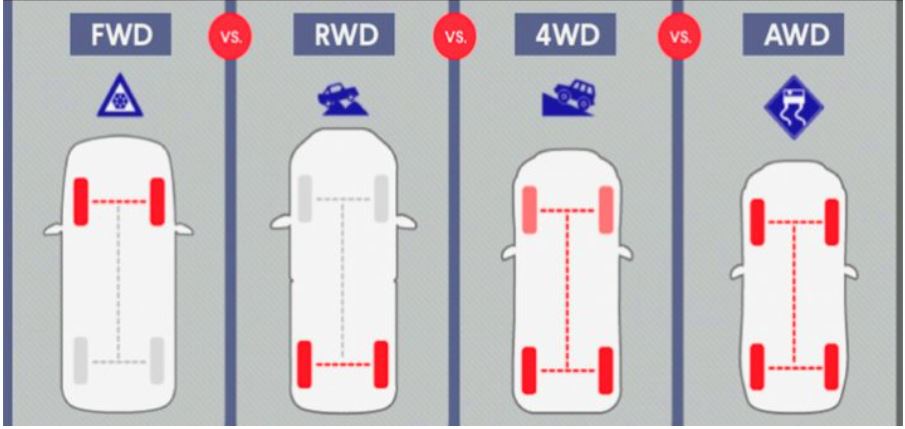
I’ve lost track of how many times a customer has rolled into my bay, popped the hood, and asked me some version of the same question: “Should my next car be all-wheel-drive? My neighbor says I need it for winter.” Nine times out of ten, that neighbor has never actually had their AWD system serviced, never checked what it costs to replace an all-wheel-drive transfer case, and definitely doesn’t know that a well-shod front-wheel-drive car with good winter tires will often outperform an all-wheel-drive vehicle running worn all-seasons. The drivetrain debate — front-wheel-drive versus rear-wheel-drive versus all-wheel-drive — is one of the most misunderstood topics in car ownership, and it’s costing people money in two directions: some are overpaying for AWD systems they don’t need and rarely maintain properly, while others are under-equipped for conditions their car genuinely can’t handle. Let’s actually break down what’s happening mechanically under each of these three layouts, because once you understand the hardware, the buying decision gets a lot easier.
Front-Wheel-Drive: The Practical Workhorse Most People Are Actually Driving
Front-wheel-drive, or FWD, means the engine sends power exclusively to the front two wheels, and the front wheels handle both steering and propulsion simultaneously. This is by far the most common layout on the road today — your Camry, Elantra, Civic, and the vast majority of family sedans and compact crossovers are built this way, mainly because it’s cheaper to manufacture and more space-efficient. There’s no long driveshaft running the length of the car to a rear differential, which means more interior cabin space and a flatter floor, and the whole drivetrain — engine, transmission, differential — sits as one compact unit up front.
When I hoist a car up on the lift, this is usually what I see with a well-maintained FWD car: a single CV axle assembly running to each front wheel (CV stands for constant velocity, referring to the joints that let power transfer smoothly to the wheel even as it turns for steering), and that’s basically the entire drivetrain complexity. Many drivers overlook this, but from a mechanic’s perspective, the real critical point about FWD is how much weight sits over the drive wheels. The engine and transmission are both up front, directly above the wheels doing the work of propulsion, so there’s naturally good traction in normal driving and even in light snow, because gravity is doing you a favor.
The tradeoff, and this is something I explain constantly, is that FWD cars ask the front tires to do everything — steering, accelerating, and most of the braking load — which is exactly why front tires on a FWD car wear out roughly twice as fast as the rears. Just last week, a client brought in a Honda Civic for what she assumed was an alignment problem because the car “pulled” slightly under acceleration. I checked her tires and found her fronts were at 3/32nds of tread while her rears were sitting comfortably at 8/32nds, never rotated once in 38,000 miles. That imbalance alone was creating the pulling sensation she felt. A $60 tire rotation, done every 5,000 to 7,000 miles, would have prevented the entire issue and saved her from needing two new front tires four months earlier than necessary.
Rear-Wheel-Drive: Better Balance, But It Comes With a Price Tag
Rear-wheel-drive, or RWD, sends power to the back two wheels while the front wheels handle steering only. This used to be the standard layout for nearly everything before front-wheel-drive took over the mass market in the 1980s for cost and space reasons, and today RWD mostly survives in performance cars (Mustang, BMW 3 Series, Genesis G70), trucks, and larger rear-drive-based SUVs.
The mechanical advantage here is genuine and significant: with RWD, you get a more even 50/50-ish front-to-rear weight distribution since the transmission and driveshaft spread mass along the length of the car rather than piling it all over the front axle. This is why RWD cars generally handle better in a spirited corner — the job of steering and the job of accelerating are separated onto different axles instead of being crammed onto the front tires alone. It’s also why RWD is preferred for trucks and towing; when you’re hauling a heavy trailer, weight shifts rearward onto the drive wheels under load, which actually improves traction rather than lifting the drive wheels light like it can on a FWD vehicle.
The real critical point I always stress to customers cross-shopping a RWD car, though, is the added mechanical complexity, and complexity means cost. You’ve now got a driveshaft running the length of the car, a rear differential (the gearbox at the back axle that splits power between the two rear wheels while allowing them to spin at different speeds through a turn), and typically two additional U-joints or CV joints on that driveshaft. I’ve had customers come in with a rhythmic clunking noise on acceleration that turned out to be a worn U-joint, and that’s a repair most FWD owners will never need to think about in the life of their car. Rear differential fluid also needs to be changed on a schedule most owners have no idea exists — typically every 30,000 to 60,000 miles depending on the vehicle — and skipping it is how you end up with a whining differential that eventually needs a full rebuild costing well over a thousand dollars instead of a $120 fluid service.
Back when I was an apprentice mechanic, one of the biggest trial-and-error mistakes I made was underestimating how much RWD traction drops in the rain or snow compared to FWD, simply because the drive wheels carry less weight than the front-heavy FWD setup and have nothing pulling them into the road surface. I test-drove a customer’s RWD sedan on a wet test loop right after a light rain, gave it modest throttle from a stop, and felt the back end step out sideways before I’d even left the parking lot. That taught me, viscerally, why RWD demands more driver respect and better tires in poor weather than most owners realize.
All-Wheel-Drive: Genuinely Useful, But Frequently Oversold and Under-Maintained
All-wheel-drive, or AWD, sends power to all four wheels, typically through a center differential or electronically controlled clutch pack that varies how much torque goes to the front versus rear axle depending on which wheels have grip. This is the system most commonly misunderstood by the general public, largely because “AWD” gets marketed as a blanket solution to bad weather, when the reality on my lift tells a very different story.
What would you do if I told you that most AWD systems on crossovers spend 90% of their driving life sending almost all power to just one axle, only engaging the other axle when a sensor detects wheel slip? That’s exactly how the vast majority of modern “on-demand” AWD systems work — they’re not constantly powering all four wheels like a dedicated off-roader; they’re front-wheel-drive-based systems that borrow rear-wheel torque only when needed, using an electronically controlled clutch pack in the rear differential. This is a smart, fuel-efficient engineering compromise, but it means the AWD hardware — that rear clutch pack, the coupling fluid, the additional differential — sits mostly unused, and unused mechanical systems have their own failure patterns, specifically clutch packs that stick or fail from infrequent engagement and fluid that degrades from age even without heavy use.
I genuinely believe AWD is one of the most misunderstood value propositions in the industry, because the traction advantage it provides is entirely about getting the car moving from a stop on slippery surfaces — it does almost nothing to help you stop or turn once you’re already in motion. That part is 100% dependent on your tires, not your drivetrain. I’ve had customers with a brand-new AWD crossover riding on worn-out all-season tires slide through a stop sign in light snow, genuinely confused about how that happened with “all-wheel-drive.” Meanwhile I’ve watched a customer’s older FWD Corolla, sitting on a proper set of winter tires, calmly climb the same icy hill that stranded several AWD vehicles riding on bald factory rubber. All-wheel-drive helps you go. It does not help you stop, and it barely helps you turn. Tires do both of those jobs, regardless of drivetrain.
Mechanic’s Essential Checklist: Comparing the Three Drivetrains
| Factor | FWD | RWD | AWD |
|---|---|---|---|
| Typical maintenance cost | Lowest — CV axles only | Moderate — driveshaft, U-joints, rear diff fluid | Highest — front + rear diff, transfer case/clutch pack, more fluids |
| Fuel efficiency | Best (lightest system) | Moderate | Worst (added weight, drivetrain drag) |
| Foul-weather starting traction | Good | Weakest | Best |
| Stopping and cornering ability | Tire-dependent | Tire-dependent, but better balance | Tire-dependent (AWD barely helps here) |
| Common failure point I see in the shop | Worn CV joints/boots (clicking on turns) | Worn U-joints (clunk on acceleration), diff fluid neglect | Rear clutch pack wear, transfer case fluid neglect |
| Ideal owner | Daily commuters, budget-conscious drivers | Performance/towing-focused drivers | Drivers in genuinely severe, frequent snow/ice conditions |
Component Service Schedule by Drivetrain Type
| Service Item | Applies To | Typical Interval | Realistic Cost |
|---|---|---|---|
| CV axle/boot inspection | FWD, AWD | Every oil change (visual) | $150–$400 per axle if replacement needed |
| Rear differential fluid change | RWD, AWD | 30,000–60,000 miles | $100–$180 |
| Transfer case fluid change | AWD, 4WD | 30,000–60,000 miles | $120–$220 |
| Driveshaft U-joint inspection | RWD | Every 30,000 miles | $80–$200 per joint if worn |
My Final Word on This
None of these three layouts is objectively “the best” — they’re simply different mechanical answers to the same question of how to get power from the engine to the pavement, and each comes with its own maintenance obligations that most owners never budget for. Before you pay a premium for an AWD trim because it feels safer, I want you to actually ask yourself how often you drive in genuinely hazardous snow or ice, and be honest about whether you’re also willing to keep four fresh, properly matched tires on that car, because AWD without good tires is a false sense of security. If you already own a FWD or RWD vehicle, go check your tire rotation history tonight, and if you own a RWD or AWD car, pull up your maintenance records and confirm your differential and transfer case fluids have actually been changed on schedule — because in my experience, that’s the single most neglected service interval in the entire industry, and it’s the one most likely to leave you with a five-figure drivetrain repair instead of a hundred-dollar fluid change.
Leave a Reply