Every week, I get at least one customer standing in my bay holding a repair estimate, staring at it like it’s written in a foreign language, asking the same question: “Wait, I thought my car didn’t have a timing belt?” This confusion is more common than you’d think, and honestly, it costs people a lot of money when they don’t understand which component their engine actually uses. Some drivers go their entire ownership experience never touching this system, while others get blindsided by a five-figure repair bill after a chain stretches out at 140,000 miles. The difference between a timing belt and a timing chain isn’t just a materials question — it’s a difference in maintenance philosophy, failure behavior, and financial risk that every driver needs to understand before it becomes an emergency.
What These Components Actually Do (And Why the Material Matters More Than You’d Think)
Before we get into the differences, let’s establish what we’re actually talking about. Both a timing belt and a timing chain do the exact same job: they synchronize the rotation of your crankshaft (the component that converts the up-and-down motion of your pistons into rotational force) with your camshaft (the component that opens and closes your engine’s intake and exhaust valves at precisely the right moment). If that synchronization is off by even a few degrees, your valves and pistons can collide inside the cylinder, and on what we call an “interference engine,” that collision bends valves, cracks pistons, and sometimes destroys the cylinder head entirely.
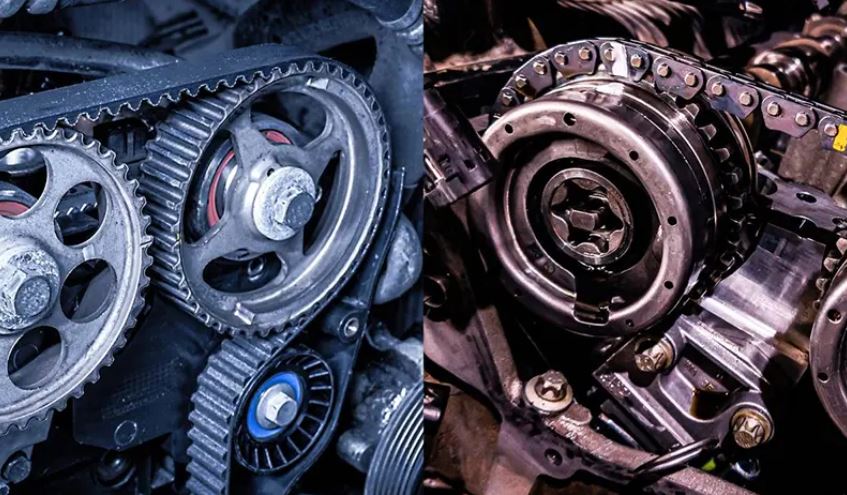
The core difference is simple on the surface: a timing belt is made of reinforced rubber with internal fiber cords, while a timing chain is metal, usually a series of interlocking links similar in concept to a bicycle chain, just far more precisely engineered. But here’s what many drivers overlook, and what I consider the real critical point from a mechanic’s perspective — the material dictates the entire maintenance philosophy of the engine. Rubber degrades. It doesn’t matter how well-engineered it is; heat, oil contamination, and age break down the rubber compound over time, regardless of mileage. Metal chains, on the other hand, don’t degrade in the same way, but they do stretch and wear at their pivot points as the engine accumulates miles. This is why belts are on a hard mileage-and-time replacement schedule, while chains are theoretically “lifetime” components that can still fail if neglected.
When I hoist a car up on the lift to inspect a timing belt that’s a few years overdue, this is usually what I see: the belt has developed fine cracks running perpendicular across its ribbed surface, almost like dried-out leather, and if I flex it between my fingers, chunks of rubber will occasionally flake off. That’s not a “maybe replace it soon” situation — that’s a belt that could snap on the next cold start.
Timing Belts: The Silent Countdown Clock
A timing belt operates on a countdown, plain and simple. Most manufacturers recommend replacement somewhere between 60,000 and 100,000 miles, though I always tell customers to check their specific owner’s manual because this range varies significantly by manufacturer and engine design. What most drivers don’t realize is that this interval is time-based as well as mileage-based. I’ve seen plenty of low-mileage vehicles, maybe a car that belonged to an elderly owner who only drove it to church on Sundays, come in with a belt that’s technically only got 30,000 miles on it but is eight years old and just as brittle as one with 90,000 miles. Rubber doesn’t care how far you’ve driven; it cares how long it’s been baking under that hood.
Here’s a scenario I want you to think about: what would you do if your timing belt snapped while you were driving on the highway at 65 miles per hour? On most vehicles, the immediate answer is that your engine simply stops running, and you’ll need to coast to the shoulder using your remaining momentum, since your power steering and power brakes may also lose assist. That’s the manageable outcome. The much worse outcome depends entirely on whether you’re driving what’s called an interference engine. In an interference design, the pistons and valves occupy the same physical space at different points in the rotation cycle, so if the belt breaks and that timing synchronization is lost, the piston can slam directly into an open valve. I’ve personally torn down engines where a snapped belt bent every single intake valve and cracked two pistons, turning what could have been a $700 preventive repair into a $4,500 engine rebuild, or in some cases, a total loss on an older vehicle.
Just last week, a client brought in a Hyundai Elantra with exactly this dilemma sitting in her driveway. She’d been quoted for a timing belt replacement by another shop about a year ago and put it off because “the car was running fine.” When it finally let go, it happened in her driveway during a cold morning start, which is actually one of the most common failure moments because cold rubber is at its least flexible. The belt job would have run her around $650 with the water pump done at the same time, which most reputable shops recommend since you’re already deep into the engine. Instead, she ended up financing a used engine swap. That’s the real-world math of skipping a belt interval.
Timing Chains: Lower Maintenance, Not Zero Maintenance
Timing chains have earned a reputation as the “set it and forget it” option, and to be fair, that reputation is mostly deserved. Because they’re metal, they don’t dry out or crack, and many manufacturers don’t publish a replacement interval at all, treating the chain as a component meant to outlast the engine itself. But many drivers overlook this, and from a mechanic’s perspective, the real critical point is that “low maintenance” doesn’t mean “no maintenance.” Chains stretch. Not in the sense that the metal links physically elongate, but the bushings and pins wear at their contact points, which effectively lengthens the chain’s overall pitch over tens of thousands of miles.
What tips me off to a stretched chain almost every time is sound, specifically a rattling noise on cold start that lasts anywhere from one to three seconds before quieting down as oil pressure builds and reaches the chain tensioner. If you’ve ever heard that sound and wondered whether it’s normal, here’s my honest answer: a very brief, faint rattle on some engines can be within normal tolerance, but if that rattle is getting louder over weeks, lasting longer, or showing up at idle even after the engine’s warmed up, you’re hearing a chain that’s stretched beyond what the tensioner can compensate for. At that point, ignoring it doesn’t just risk a chain snapping outright, which does happen, but more commonly it causes your camshaft timing to drift out of spec gradually, which the engine’s computer will eventually flag as a check engine light for cam timing correlation, often paired with a noticeable loss of power and rough idle.
I still remember, back when I was an apprentice mechanic, one of the biggest trial-and-error mistakes I made involved a chain-related noise complaint. I assumed a rattling noise on a customer’s V6 was just a loose heat shield, something cosmetic and harmless, because chain problems weren’t something I’d been trained to listen for yet. It turned out to be a badly worn chain guide, and by the time we caught it three visits later, the guide had fragmented and dropped debris into the oil pan, contaminating the oil pump pickup. That mistake taught me to never dismiss a rattle on a chain-driven engine without at least pulling the valve cover or running a compression and timing check.
Comparing the Real-World Costs and Risk Factors
Numbers help put this in perspective, so here’s how these two systems typically stack up when you’re budgeting for ownership costs.
[Mechanic’s Essential Checklist: Timing Belt vs. Timing Chain]
| Factor | Timing Belt | Timing Chain |
|---|---|---|
| Typical Replacement Interval | 60,000–100,000 miles (check owner’s manual) | Often “lifetime,” but realistically 100,000–150,000+ miles if worn |
| Material Behavior | Degrades from heat/age regardless of mileage | Wears/stretches from mechanical friction over mileage |
| Preventive Repair Cost | $500–$900 (with water pump) | N/A unless proactively replaced (rare) |
| Failure Repair Cost (Interference Engine) | $3,000–$6,000+ for valve/piston damage | $2,500–$5,000+ if chain snaps or jumps timing |
| Early Warning Signs | Visible cracking, glazing, fraying edges | Cold-start rattle, check engine light for cam timing |
| Routine Inspection Needed | Yes, visual inspection at every oil change | Yes, listen at cold start, check for metal debris in oil |
One point I want to underline from this table: even though chains carry a reputation for being maintenance-free, the failure cost when something does go wrong is comparable to, and sometimes worse than, a belt failure, because chain problems often come with secondary damage to guides, tensioners, and sometimes the oil pump chain drive on the same system.
My Final Verdict and What You Should Do This Week
If your vehicle uses a timing belt, don’t treat that manufacturer-recommended interval as a suggestion. I understand it feels like paying for something that “isn’t broken yet,” but that’s precisely the nature of a rubber component — by the time it shows obvious symptoms, you’re often already living on borrowed time. Pull out your owner’s manual this week, find your specific interval, and check your maintenance records or your odometer against it. If you’re within 10,000 miles of that number and don’t know your belt’s replacement history, treat it as due now rather than risk a roadside failure.
If your vehicle runs a timing chain, your job is different but not optional. Pay attention to cold starts. That one-to-three-second window right after you turn the key is when a stretched chain announces itself most clearly, so make it a habit to actually listen rather than immediately blasting your radio or heater fan. If you notice a new or worsening rattle, get it checked before it becomes a check engine light, and definitely before it becomes a stranded car on the side of the road.
Whichever system your engine runs, the underlying lesson is the same: these components fail quietly for a long time before they fail loudly and expensively. A few hundred dollars spent on the right inspection or replacement now is always cheaper than the alternative sitting in my shop with a busted engine and a much heavier bill.
Leave a Reply